
On June 26, 1944, architect Peter P. Dupay (1900-1985) obtained a building permit for an addition to a residence on Sixth Street in Basking Ridge.[1] But where was Sixth Street? And if Basking Ridge had a Sixth Street, where were First through Fifth?

The answer is provided by an 1891 map[2] showing what was called Basking Ridge Park in the area to the west of Basking Ridge Railroad Station. Sixth and Seventh streets are shown running east-west parallel to Conklin Street in the area now occupied by I-287. The area was divided into small “picnic lots’ which were marketed to city folks. In theory, the owners would travel to Basking Ridge by rail and enjoy a picnic on their own plot of land. The plan was never fully developed, but some street names like Sixth became more than just paper streets.
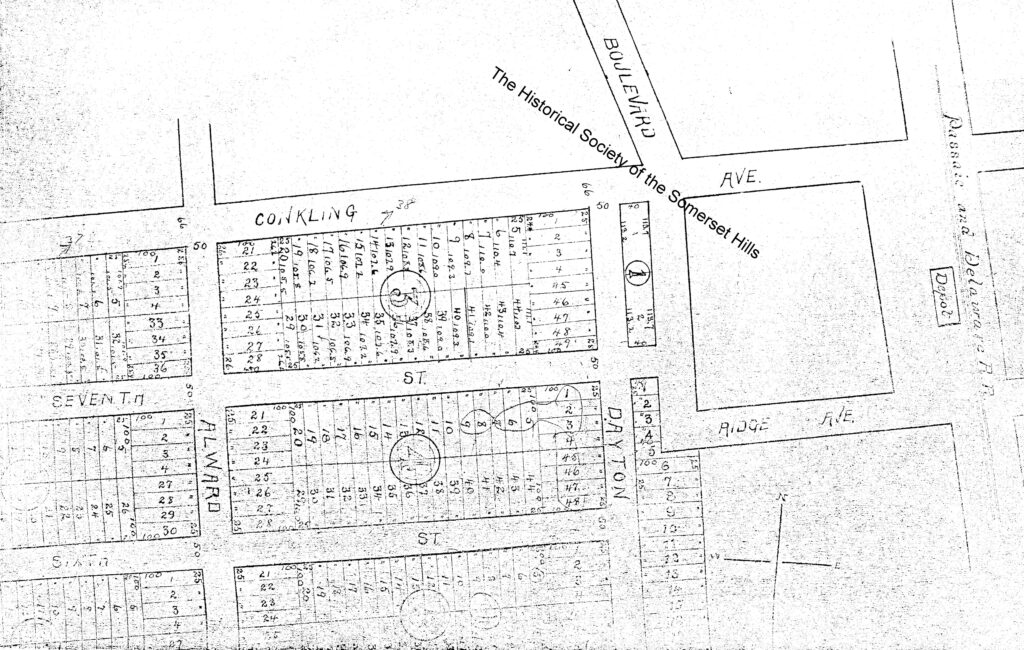
In 1952, when Bernards Township officially named Evergreen Place (off Washington Ave.), it noted that the street was previously known as Second St.[3]
[1] Bernards Township Building Permits, Jan. 1944 to Sep. 1944.
[2] Map #1, Basking Ridge Park, owned by Thomas Welwood, Filed Oct. 5, 1891.
[3] Bernardsville News, Oct. 23, 1952, p. 2.



Not sure where you got your information about “picnic” lots, but a 25′ x 100′ lot was a standard size building lot in 1891.
Hi Joseph,
Maybe they were standard in Jersey City, but these were tiny for Bernards Twp. I’ve always heard them called “picnic lots.” The local paper has referred to them as such “The small lots are the remnants of a real estate scheme from the late 1900s when the area was subdivided into hundreds of privately owned, 25-by-100 foot “picnic” lots. Many of the buyers came out by train to hold picnics on their land but few ever settled here and taxes were neglected (Bernardsville News, Mar. 5, 1998, p. 2).” I’ve also found the term “picnic lots” used in the Chesapeake Bay area, “At one time the Washington Post gave away 100-foot ‘picnic lots’ with every subscription, so there are oodles of tiny lots. If they were to be developed, it would be disastrous.” (Anne E. Byrnes, Saving the Bay (2001), p. 19).