
Architectural and Cultural Significance
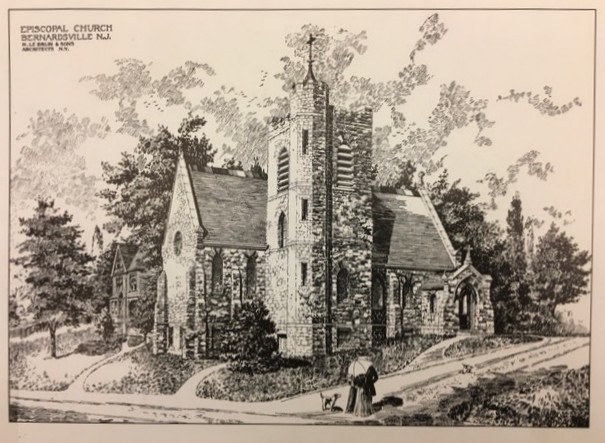
St. Bernard’s Church and its original parish house in Bernardsville, New Jersey, are architecturally and culturally significant, in part because they were designed by two of America’s leading architects of the late nineteenth and early twentieth centuries. Moreover, the church features a notable set of English stained glass windows.
The architectural firm of Napoleon LeBrun & Sons designed the original church and its 1904-05 extension; and Henry Janeway Hardenbergh designed the original parish house, which was completed in 1913. Another prominent ecclesiastical and collegiate architect, Ralph Adams Cram, designed interior and exterior memorial doors for the church in the 1930s.
St. Bernard’s Church is also distinguished by having what is said to be the most complete cycle in the United States of stained glass windows designed and manufactured by the same leading English firm—the Kempe Studio of Stained Glass and Church Furniture, later called C.E. Kempe & Co., Ltd., that was originally established in 1866 by Charles Eamer Kempe (1837-1907).
The history of St. Bernard’s Church is also particularly notable for the work of its second rector, Rev. Thomas Anderson Conover, who had a 40-year tenure that began in November 1899. As the territory initially served by the new St. Bernard’s parish was quite large, Rev. Conover was instrumental in establishing several other Episcopal mission churches in the area, each now a separate parish, but collectively still fondly known as the “The Conover Parishes” or the “The Conover Churches.” These include St. Luke’s in Peapack-Gladstone, All Saints in Millington, St. John on the Mountain in Bernardsville, and, briefly, St. Matthew’s in Far Hills.
Rev. Conover was also instrumental in establishing many social service efforts, both within and outside St. Bernard’s parish. For example, in 1903 the church employed a visiting nurse, whose duties were soon taken over by the newly organized Visiting Nurse Association of the Somerset Hills. And, from 1915 to 1940 Conover served as the chaplain of the New Jersey State Reformatory for Women.
In 1900 Rev. Conover established the St. Bernard’s Farm School in Peapack-Gladstone. Reportedly, Conover only accepted the rectorship of St. Bernard’s Church provided he would be able to obtain the necessary support for the establishment of a boarding and day school for farm and village boys. The school was successful, and in 1972 what was then called St. Bernard’s School merged with the Gill School for girls in Bernardsville to form today’s co-educational Gill-St. Bernard’s School located on the original St. Bernard’s campus in Peapack-Gladstone.
Early History
In 1853 St. Peter’s Episcopal Church in Morristown established a mission chapel, St. Mark’s, in Basking Ridge. In 1874 the Basking Ridge chapel became a mission of St. Mark’s Episcopal Church in Mendham.
In 1898, St. Mark’s in Basking Ridge became a mission of St. Bernard’s, although in a sense St. Mark’s could also be considered the mother church for St. Bernard’s, as it was older and its vicar in the 1890s, Rev. Joseph C. Hall, left St. Mark’s to become the first rector of St. Bernard’s.[1]
Beginning in the early 1870s, wealthy entrepreneurs and financiers from New York, Newark, Brooklyn and other areas of New Jersey began buying land in the higher, cooler elevations of the verdant rolling countryside of the Somerset Hills where they soon built elaborate country estates. The railroad, which arrived in Bernardsville in 1872—and was extended to Far Hills, Peapack, and Gladstone in 1890—served to make the area even more accessible and desirable. Also, the Somerset Inn, a large and luxurious summer resort hotel that stood along the Bernardsville-Mendham Road until 1908, served to introduce more and more prominent and affluent guests to the area, some of whom returned to buy land, build homes, and stay.
As a result of these changes, the religious needs of the Somerset Hills also changed and became more diverse.
In October 1896 a small group met to elect trustees and proceed to organize an Episcopal church at Bernardsville, in part because the small St. Mark’s chapel in Basking Ridge was considered too far away by horse and carriage.
A building committee was formed consisting of Robert Livingston Stevens of the prominent and wealthy Hoboken family; George B. Post Jr., the eldest son and namesake of the famous New York architect who was a Presbyterian and attended the Basking Ridge Presbyterian Church; and Rev. Joseph C. Hall, the priest then in charge of St. Mark’s chapel in Basking Ridge.
By June 1897, Rev. Hall was appointed rector of the newly organized St. Bernard’s Church and served in that post until 1899.
St. Bernard’s is most likely named for St. Bernard of Clairvaux, although not for any strong wish to honor the saint, who is primarily considered a Roman Catholic saint, but simply because of the name of the community in which the church is located.
Designing and Building the Church
It was primarily at the instigation of Bernardsville resident Haley Fiske (1852-1929) that the New York architectural firm of Napoleon LeBrun & Sons was selected to design the new St. Bernard’s Church. As noted below, Fiske had several significant connections to the LeBrun firm.
The firm was established in Philadelphia in the mid-nineteenth century by Napoleon Eugene Henry Charles LeBrun (1821-1901). LeBrun left a notable design legacy in Philadelphia with his designs of, among other things, the Academy of Music and the Roman Catholic Cathedral of St. Peter and St. Paul. He relocated to New York City in the 1860s and his sons joined the practice in the 1880s.
In the 1880s and 1890s the LeBrun firm became the official architects for the New York City Fire Department. The firm was also responsible for some notable office buildings in New York, such as the Home Life Insurance Building across from City Hall on lower Broadway (extant), and, most significantly, the original Metropolitan Life Insurance Building on Madison Square Park (built in 1893 but later demolished and replaced) and the adjoining iconic Metropolitan Life Tower, which is extant although somewhat altered. The tower building, designed and built between 1905 and 1909, was, at 700 feet, the tallest building in the world until the Woolworth Building was completed four years later, in 1913.
As a Roman Catholic family of French origin, Napoleon LeBrun and his sons were not known for their designs of many Episcopal churches. However, and significantly, the firm had designed Haley Fiske’s New York City Episcopal church, St. Mary the Virgin on West 46th Street.
Fiske, who was trained as a lawyer, became a very influential vice president of the Metropolitan Life Insurance Company and would undoubtedly have been involved in the selection of the LeBrun firm to design the new Metropolitan Life buildings on Madison Square. In 1919, Fiske became president of Metropolitan Life and served in that office until his death ten years later.
In 1892 Fiske and his family came to Bernardsville where they bought a large tract of land on the so-called Mountain and developed it into an elaborate country estate they called “Overcross.” Fiske engaged the LeBrun firm to design additions and alterations to the original house on the property, thereby further cementing Fiske’s business, residential, and religious ties to the firm.
The architectural style selected for St. Bernard’s Church was the then-popular early English Gothic. Since the mid-nineteenth century, Gothic Revival had become a popular style for the Church of England and for the American Episcopal church. The Gothic style was believed to express in architecture a religious movement that arose at Oxford and Cambridge in the 1830s and 1840s that espoused a return to what was considered the more traditional and purer form of worship of the medieval church, essentially the Anglo-Catholic tradition.
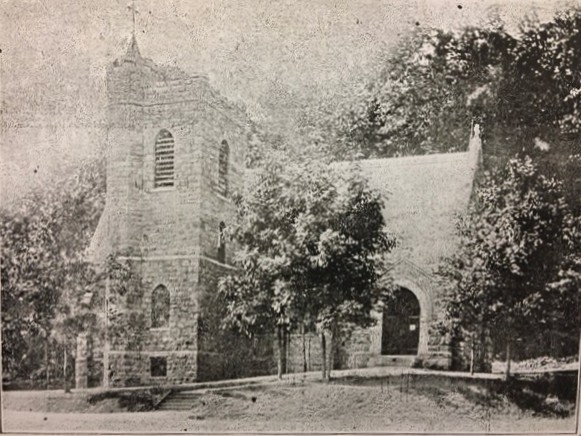
The cornerstone of St. Bernard’s was laid July 8, 1897, and construction—by the stonemason John M. Hoffman of Mendham—moved quickly. The church opened and was consecrated in June 1898.
A brief note is warranted regarding the stonemason, John M. Hoffman (1862-1925). In addition to constructing both St. Bernard’s Church and parish house, Hoffman also built many other notable structures in the Somerset Hills. These included the Olcott School (designed by Henry J. Hardenbergh and donated by Frederic P. Olcott), the present Bernardsville train station, the Episcopal convent of St. John the Baptist and St. Margaret’s Church in Mendham, buildings on what is now the Gill-St. Bernard’s School campus in Peapack-Gladstone, as well as many of the large estate houses on the Bernardsville Mountain.
Given the physical proximity of the Catholic and Episcopal churches in Bernardsville, it should be noted that they were both established at about the same time. Although Roman Catholic and Episcopal church services had long been held for guests at the Somerset Inn on the Mendham Road, in 1898, the year St. Bernard’s Church was completed, a Catholic priest, Father Joseph A. Ryan, was sent to Bernardsville to establish a new parish. Two years later, in 1900, Our Lady of Perpetual Help Church was completed. The church was dedicated and consecrated on the same day, largely due to a major donation made by Bernardsville resident Frederic P. Olcott. Although he was not a Catholic, Olcott reportedly underwrote about 50% of the church’s original construction cost.
Changes in the Pastorate and the Building
In 1899 Rev. Joseph C. Hall resigned as rector of St. Bernard’s. His successor, Rev. Thomas Anderson Conover, came in November of that year and served for the next 40 years.
Conover was initially reluctant to take the position of rector. His primary interest lay not in being a parish priest but in starting a farm school for boys. Conover accepted the call only when he was assured he would have a curate to assist him, thus allowing Conover the time to establish his school. For the first four years of his pastorate, Conover and his wife lived on the former Hillard farm in Gladstone where he had established St. Bernard’s Farm School.

In July 1904, given the rapid growth in the size of St. Bernard’s congregation, the LeBrun architectural firm was called upon again to design an addition to the church. The addition, completed in 1905, added about 30 feet at the western (parking lot) end and added two bays to the nave.
What had been the original main entrance located on the north side (see the attached rendering by the LeBrun firm [Figure 1] and an early photograph [Figure 2]) was turned into the baptistery and the main entrance was relocated to a vestibule in the newly added section at the west end of the nave (Figure 3). At the same time, the church was fitted out with electric lighting and a heating plant.
The present narthex at the west end of the church, designed by William G. Halsey of Basking Ridge, was added in 1957-58 following a major fire at the church. Another serious damaging fire occurred in 2004.
Several interior changes and alterations have been made over the years, although not discussed in detail here. These included, however, the creation of a larger choir area around 1910-11 and the replacement a few years later of some of the original wooden flooring with marble.
St. Bernard’s Cemetery
Between 1903 and 1905 St. Bernard’s Cemetery on Washington Avenue in Bernardsville was laid out and consecrated. The land and large Celtic cross near the entrance were gifts of prominent congregant Robert Livingston Stevens. The cemetery’s extant stone lodge was built and consecrated in 1905. Its architect is not known.
The Stained Glass Windows
Except for (a) the round rose window on the east end of the church, which was manufactured by the London firm of Clayton & Bell, and (b) the windows in the narthex (built 1957-58), all of the stained glass windows at St. Bernard’s Church were designed and manufactured by the Charles E. Kempe firm of London, England. St. Bernard’s is said to have the most complete cycle in the United States of stained glass windows designed and manufactured by the same leading English company.
Other examples of the Kempe firm’s work in this country include the Bethlehem Chapel at the National Cathedral in Washington, the Church of the Incarnation in New York, and Christ Church in New Haven.
Walter Graeme Ladd, who was a member of the St. Bernard’s congregation and the husband of noted philanthropist and healthcare advocate Kate Macy Ladd, donated the funds for eight of the stained glass windows at St. Bernard’s. The windows were given in memory of various Macy and Ladd family members as well as Alice Lemley, Mrs. Ladd’s devoted nurse and companion for nearly 25 years.
To clear up a bit of mistaken local lore about St. Bernard’s windows, the present rector, Rev. Beth Rauen Sciaino, has advised that it was a set of the Kempe firm’s drawings for the stained glass windows at St. Bernard’s, not the windows themselves, that were lost in the 1912 sinking of the R.M.S. “Titanic.”
By the end of April 1914, all of the Kempe-designed windows except one were in place.
Parish House
Although discussions about building a parish house began in 1904 at the same time plans were being made to enlarge the church itself, nothing came of it at that time. Four years later, in 1908, Rev. Conover was more successful in his pursuit of building a parish house. The church trustees authorized him to solicit subscriptions for a building and to obtain designs from the LeBrun architectural firm. Although plans were apparently drawn up, nothing came of the parish house project at that time either.
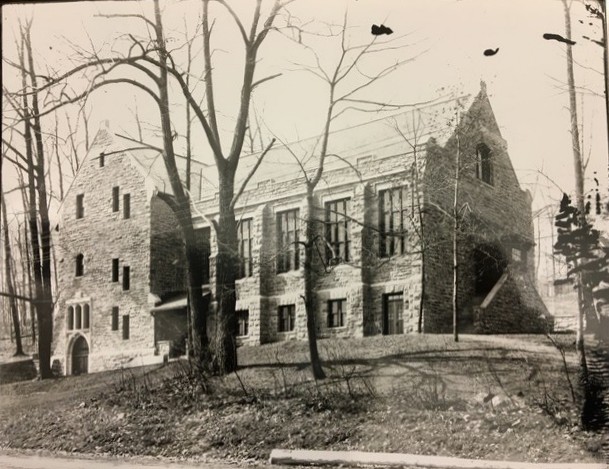
About three years later, however, the church turned to one of its own congregants, prominent New York architect and Bernardsville resident Henry Janeway Hardenbergh (1847-1918), to draw up new plans for a parish house. Hardenbergh presented an initial design in March 1911. Final plans and a contract were drawn up around February 1912, and construction—again by the John M. Hoffman firm—was nearly complete by March 1913. The building officially opened in May of that year (see Figure 4).
Hardenbergh was not generally known for his church architecture, although one of his earliest commissions was for the Kirkpatrick Chapel on the Rutgers University campus in New Brunswick. Hardenbergh, who had old and deep family ties to Rutgers, designed the chapel, which is extant, in 1873 in a High Victorian Gothic Revival style.
Hardenbergh is primarily known today for his design of one of America’s first luxury apartment houses, The Dakota (1880-1884) on Central Park West at 72nd Street in New York, and for his many designs of luxury hotels, such as the Plaza in New York (1905), the Willard in Washington (1906), and the Copley Plaza in Boston (1912). Hardenbergh had first established his reputation as a designer of large luxury hotels with the 1893 Waldorf Hotel and the adjacent Astoria Hotel, built in 1896. Both buildings were razed around 1929-30 to make way for the Empire State Building.
In addition to the St. Bernard’s parish house, Hardenbergh’s architectural work in the Somerset Hills included the Olcott School building and his own country estate house, “Renemede,” in Bernardsville and for his collaboration with prominent Boston architect Guy Lowell, who was the principal architect, on the design of “Natirar,” the residence of Kate Macy and Walter Graeme Ladd in Peapack.
The design of the parish house for St. Bernard’s can best be described as a simpler, more-modern Gothic, or as the nomination for St. Bernard’s to be added to the National Register of Historic Places has called it, “starved Gothic.” The building also reflected some influences of the English Arts & Crafts movement.
In its more-modest, simpler design, the parish house, perhaps because it was sited on higher ground overlooking the church, intentionally deferred to the more-elaborate and more traditionally Gothic design of the church. Nevertheless, its design refers to the church through the use of the same stone building material and the incorporation of such Gothic design motifs as castellation and flattened buttresses between the windows.
In recent years, the original St. Bernard’s parish house has been converted into condominium residential units, part of an apartment development called The Heritage at Claremont.
Rev. Thomas Anderson Conover
Rev. Thomas Anderson Conover (1868-1943), who served as the rector of St. Bernard’s for some 40 years, beginning in 1899, was an activist priest. He moved quickly to create organizations within the parish, including a Sunday School, Women’s Auxiliary, Altar Guild, Parish Library, and Boys’ Club.
In 1903, he arranged for the church to employ a visiting nurse, a function that was taken over not long after by the newly established Visiting Nurse Association of the Somerset Hills. In 1910, at Conover’s urging, St. Bernard’s also sponsored Bernardsville’s first social worker.
As referenced above, Conover also extended the reach of St. Bernard’s by establishing or otherwise supporting mission churches or chapels throughout the area. These came to be known as the “The Conover Parishes” or “The Conover Churches.”
In addition to St. Bernard’s itself, the Conover Parishes initially included St. Mark’s in Basking Ridge. Although established in 1853 as a mission of St. Peter’s Episcopal Church in Morristown, St. Mark’s was, in a sense, the mother church for St. Bernard’s.
Other missions established by Rev. Conover included St. Luke’s in Peapack-Gladstone (1904), All Saints in Millington (1906), and St. John on the Mountain in Bernardsville (1907). Even before these church structures were built, however, Episcopal religious services were held in each of the communities, either outdoors or in residences or other buildings, such as schools, the Somerset Inn, or, in one case, a carriage barn and stable. Rev. Conover was fortunate in that he was able to enlist lay preachers as well as trained curates to serve each of these congregations. Each of these mission churches is now a separate, independent parish.
From 1901 to 1903 Episcopal services were also held in Far Hills. Known during its relatively brief existence as St. Matthew’s Mission, church services were held in the former school building on the Far Hills Fairgrounds that had been donated to the community by Grant B. Schley, whose Far Hills estate was called “Froh Heim.” St. Matthew’s Mission was discontinued when it became evident it was too close to St. Luke’s in Peapack-Gladstone to justify a separate church.
Before St. John on the Mountain was built, in 1907, Sunday services in that section of Bernardsville were held in a former schoolhouse on Mountain Top Road (opposite Roebling Road) and on various estates on the Mountain, notably in the extant stone stable and carriage barn on the “Upton Pyne” estate of Percy R. Pyne.
As noted above, Conover’s other significant work was the establishment, in 1900, of St. Bernard’s Farm School on the former Hillard property in Peapack-Gladstone, now the campus of the Gill-St. Bernard’s School. It was Conover’s desire—perhaps based on his own experiences attending St. Paul’s School in Concord, New Hampshire—to establish a boarding and day school for farm and village boys where they could be educated while also learning a trade. It was in obtaining the support for the establishment of such a school that caused the initially reluctant Conover to accept the call to become rector of St. Bernard’s. Until 1904, Conover and his wife even lived on the school’s campus in Gladstone before moving to Bernardsville.
W. Barry Thomson
2025
[1] Rev. Joseph C. Hall is not to be confused with Rev. Edward Wheeler Hall, a later curate of St. Mark’s in Basking Ridge. Edward Hall left St. Mark’s in 1909 to become rector of St. John the Evangelist Episcopal Church in New Brunswick. In 1922, Edward Hall was one of the two victims—the other being church choir member Eleanor Reinhardt Mills—in the famous Hall-Mills murder case.




This is an AMAZING historical capture of not only this church, but of also what is known today as the Somerset Hills. This could be a Hollywood movie or a TV series. It relates so much to today’s world, revealing how much “connections” matter. Everyone should read this. It is most entertaining.
I am extending a huge Thank You to W. Barry Thomson for writing this article. It is a treasure for the archives of The Historical Society of the Somerset Hills.