Belfast: A Slave in the Revolution
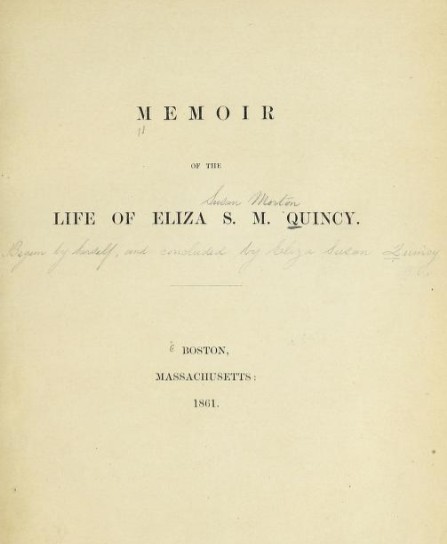
The Memoir of Eliza Susan Morton Quincy (1773-1850) includes a vivid description of Basking Ridge, NJ, during the Revolution. Excerpts from the memoir were published in the Somerset County Historical Society Quarterly (Vol. 1 & 2) in 1912 and 1913. The Basking Ridge Historical Society reprinted these excerpts in a booklet for the Bernards Township Bicentennial in 1960. But the excerpts in both reprints omitted some fascinating passages about a Morton family servant–a slave named Belfast.
From the Memoir of the Life of Eliza S.M. Quincy (1861), accessed on Internet Archive. See full text at: https://archive.org/details/memoiroflifeofel01quin/page/n5/mode/2up
[pages 19 and 20]
“There were several women employed as domestics in our family, and a negro man—Belfast—who deserves a particular notice. He was a boy of nine years old when my father [John Morton] purchased him; a mode of securing service then considered as proper as by wages.
There is no subject on which the opinions of society have undergone so great a change as upon that of slavery. The iniquity of the cruel treatment of field slaves, on plantations in the Southern States, was at that period acknowledged; but in the Middle and New England States, where they were domesticated and kindly treated, slavery seemed to have lost its horrors. The owners of negroes appeared entirely unconscious of the guilt of bringing them forcibly from their own country to one where they were better off in some respects; and thought it was doing them a service, though against their will. The fact was, their minds had never been turned to reason on the subject. I remember the great surprise I felt, the first time I heard an intimation that it was wrong to hold a slave, although the truth of the proposition was so self-evident that it needed only to be stated to be allowed by an unprejudiced mind.
Belfast was so named from the port to which the captain belonged who sold him to my father. He was kindly brought up, instructed in reading and writing; was faithful, honest, and cheerful, and gratefully attached to his master and the family. We children were very fond of him. I was his great favorite; and he often carried me up and down the hill, and from school, in his arms. He used to sing and dance for our amusement, and to play on the comb, for us to dance; in which accomplishment he was also our instructor. Yet such was his respectful familiarity, that he never offended in either word or action. He was an excellent cook, and ready at all kinds of work within and without the house.
At a period and in a situation when assistance was difficult to obtain, Belfast was an invaluable domestic. After our family returned to New York, he married, and asked and obtained his freedom. He always sustained a good character, but did not long survive leaving his old home. The change probably was not for the better, — for his comfort and happiness; but he enjoyed the gratification of being a free man. A good man he certainly was, to the best of his knowledge and ability; and I never think of him, even at this period of my life, but with respect and affection.
[page 26]
The British Army never penetrated to Baskingridge; but there were repeated alarms of their approach with fire and sword; and the children were often sent in wagons to cottages among the hills, several miles distant, –considered places of safety. On one of these occasions, I was sent at night, with my sister and my brother Washington, to a Mr. Gobles, in the woods. We were placed on our beds in the wagon; and well covered up, as it was very cold, were driven by Belfast, who cheered and encouraged us in our darksome expedition. At our place of refuge we were received very kindly by the good woman of the cottage, who gave us some bread and milk; and spread our beds on the floor. But great was my astonishment at her arrangement for her own children: she raised some boards in the corner of the only room in the house, under which there was a bed of dried leaves, where they were placed, and covered with their clothes and a blanket. I was very much afraid I was to be put in there too; but Belfast comforted me by saying he would take care of me, and sit up all night by the fire, which he did, with the hospitable owners of this humble roof.”
Belfast is also mentioned in passing on page 29.