The Folly
The Natirar estate included historically important areas that long predated the early 20th century country estate era.
Lying deep under the Peapack-Far Hills Road — where New Jersey Transit’s Gladstone Branch line also passes under the road — are the now-closed-off entrances to a tunnel long known as the “Folly.”
The tunnel was excavated around 1766, ten years before the start of the American Revolution. The purpose was to divert some of the water from the North Branch of the Raritan River to the Peapack Brook to provide increased waterpower for the gristmill, sawmill, bark mill, and leather tanning operation located downstream just above the intersection of Old Dutch Road and Far Hills Road.
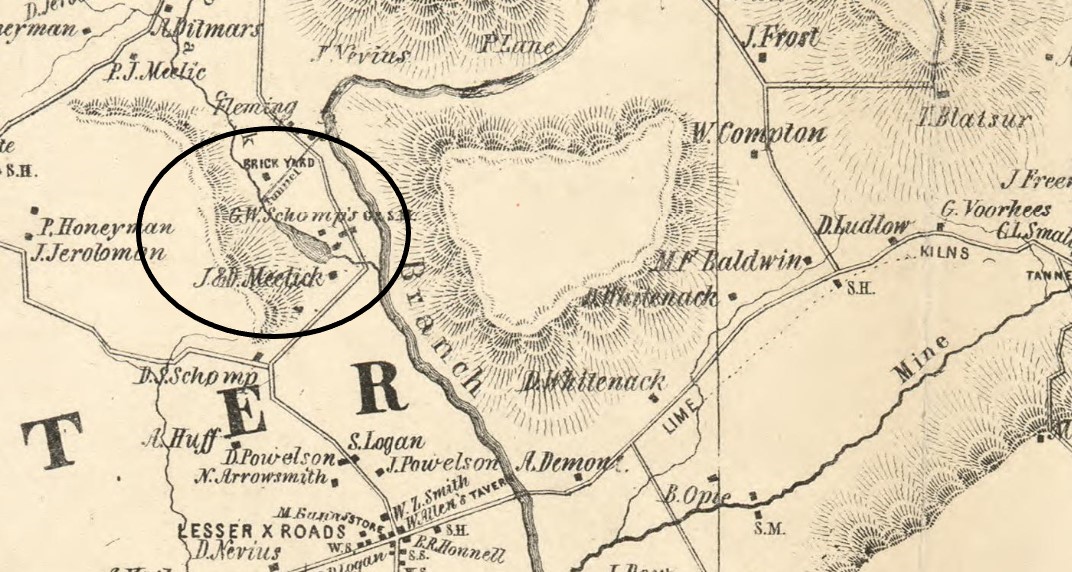
With mill operations dating from around 1750, the area constituted what was most likely the Somerset Hills’ earliest rural industrial district. A later, mid-19th century gristmill still stands on the property.
The water tunnel was dug about one-quarter mile upstream where the North Branch runs closest to the Peapack Brook, the two waterways being separated by a narrow hill long known as the Hogback.
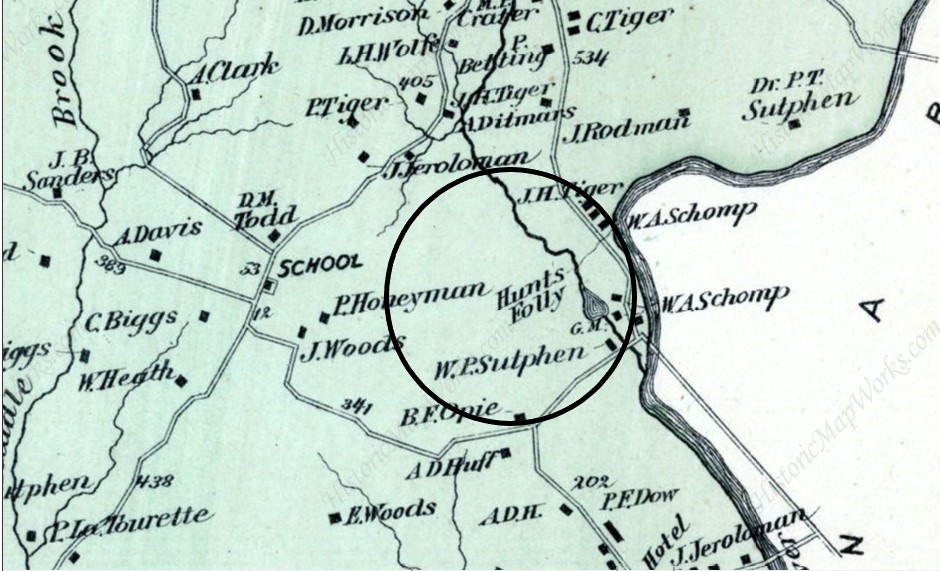
Both the tunnel and the former mill area downstream were, and remain, part of the Natirar property.
Andrew D. Mellick Jr., in his 1889 book, The Story of an Old Farm or Life in New Jersey in the Eighteenth Century, wrote about the Folly. He reported that a dam was first constructed on the North Branch to raise the water level high enough to enter the tunnel. Continuing his account, Mellick wrote that:
The hill [Hogback] was then tunneled, forming an aqueduct six feet high and three feet broad; it being constructed on an incline, a considerable quantity of additional water was, through it, led into the smaller stream [the Peapack Brook], thus greatly augmenting the powers of the [Brook] in serving the mills [downstream] near its mouth. With the strange fatality that often attaches to local nomenclature in rural communities, this undertaking has always been known as the “Folly.” It may have been because the results secured were not considered commensurate with the outlay.
Exploring the still-accessible tunnel as a young boy, Mellick, speaking of himself in the third person, went on to write:

Pushing aside the vines that partially hid the low entrance to the tunnel, he boldly groped his way into the very bowels of the earth. Altogether it was a solemn sort of place for a small boy to find himself in. The walls were moist and slimy . . . [and] on nearing the centre of the dark and gloomy conduit daylight gradually disappeared, and courage began to ooze away. Suddenly, a jagged dripping wall opposed further advance. Thinking that the aqueduct had come to a sudden end, for a moment terror paralyzed all efforts at progress, but discovery was soon made that it turned sharply to the left. Its construction had been simultaneously undertaken from both sides of the hill; [and] through miscalculation the workers had failed to meet in the centre, rendering a double elbow in the tunnel necessary.