
UPDATE: The following text describes the successful efforts by The Historical Society of the Somerset Hills to restore the the Moses Craig Lime Kilns after they were acquired by the society in 1998. In 2019, ownership of the kilns was transferred to the Borough of Peapack-Gladstone.
Most people don’t know that in 1999, a Peapack land owner donated the lime kilns an the surrounding property to The Historical Society of The Somerset Hills. The Society owns and maintains the kilns and the surrounding area and has continued over the years to raise funds to maintain the property installing the information boards, and maintaining the grounds in partnership with the Peapack/Gladstone Municipal services. But the kilns were in need of a major facelift.
The grant serves multiple purposes; to prepare and submit a NJ and National Register nomination application for the property, mortar analysis, archaeological monitoring, and design and construction administration services for the proposed construction work. THSSH trustee Dan Lincoln is leading the effort. The project and grant was finally approved by Somerset County Cultural and Heritage Commission (SCCHC) grant on October 27, 2015 for $122,600.
Dan Lincoln from THSSH has been the leader of the restoration project. Assisting the Society is Pat Delaney, representing the Peapack Gladstone Historic Preservation Commission. “Limestone quarrying was Peapack’s leading industry for much of the 1800s and 1900s, producing fertilizer for farms throughout the area,” said Delaney. ““It’s a terrific project.” she said. “The lime kilns are a major part of our agricultural and industrial past. We want to preserve them so future generations can know what they were all about.”
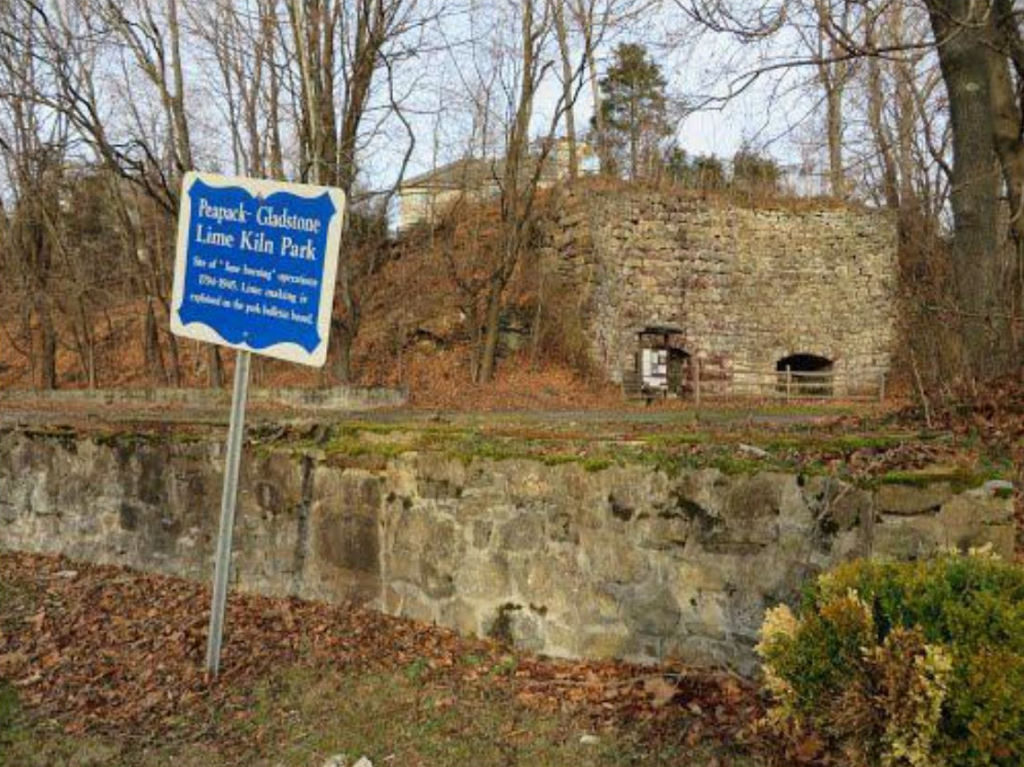
The first phase of the restoration was to remove brush,trees, and lose mortar above and around the kilns and was completed in September 2016. Dan Lincoln, who’s overseeing the effort along with with Dennis Bertland (consultant) and the architect, John Bolt worked to begin the process to place the lime kilns on the National Register of Historic Places and commence the stabilization efforts. The site was declared eligible (certificate of eligibility) for historic nomination in February 17, 2015.
In 2016, THSSH hired local archeologist Dr. Richard Veit along with John Bolt Architect to do additional research on the physical aspects of the Kiln and the area surrounding the kiln. Click Here to read the report. These shovel tests in front of the kilns determined the original ground surface that will need to preserve the kilns for the future.
2017 Restoration Effort
THSSH moved forward based on a number of received quotes to perform the restoration. Vince Iacampo of Iacampo, LLC of Long Valley, New Jersey was selected to perform the execution of the Somerset County grant award. The project started in the spring and should be completed in the fall of 2017.
Vince Iacampo indicated that the fir trees on top of the kiln should be removed in order to grade the earth away from the face of the kilns.
John Smith, landscape architect, proposed a buffer landscape in their place to appease the neighbors at the top of the kiln.
Architect John Bolt suggested in the future that the Society consider some kind of uplighting on the face of the kilns.
“The project has been moving along smoothly and we’re on schedule,” said Dan Lincoln, who’s been leading the effort acting as custodian of the grant. “The Society’s been working with the Peapack Gladstone Historic Preservation Committee to get the project done and we appreciate their support of the project.” The commission plans to install new signage on the property once the restoration is complete.
Vegetation has been removed from the face of the kilns. The berm of earth in front of the wing wall was tapered back and prepared for landscaping. During the clearing, a large concrete platform has been unearthed with evidence of previous shed foundations. Vince Iacampo, contractor at the site commented; “The left hand kiln re-pointing is complete, including the vaulted roof of the throat. Work will start on the voussoirs and corner stones on both openings once the right hand kiln has been re-pointed.” The right hand kiln is re-pointed roughly 3 feet down from the top.
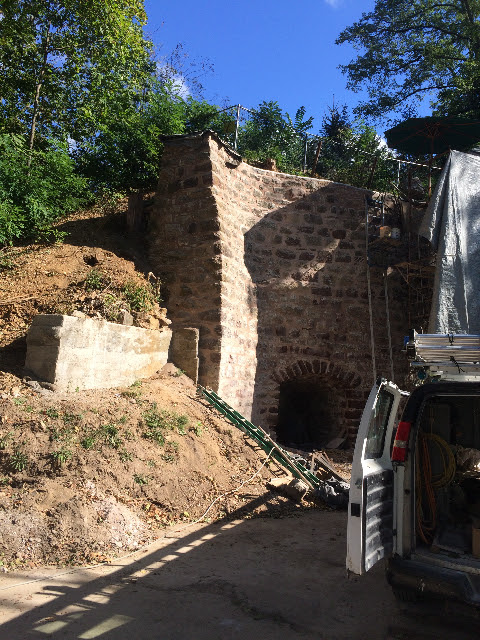
The stone wing wall on the right hand side recently uncovered was apparently built to prevent wash and earth cascading down the hill
onto the working plane in front of the kilns. (see photo). The concrete wing wall on the left hand side was apparently installed for
similar reasons, but does not appear to descend to the grade of the kiln throats, thus the earth bank in front of it for support.
A special thanks to Dan Lincoln, THSSH Trustee for leading the entire restoration effort representing the Society, the PG Historic Preservation Commission and the Somerset County Cultural and Heritage Commission. It’s a big volunteer effort!
Lime Kiln History
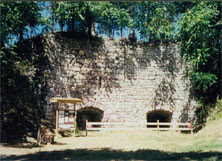
Often unnoticed, the Peapack Lime Kilns is a historic reminder of what was once one of the most important manufacturing processes in our areas history.
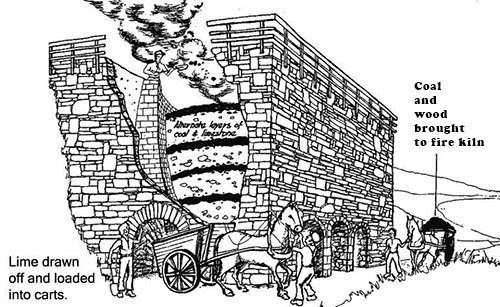
The common feature of early kilns was an egg-cup shaped burning chamber, with an air inlet at the base (the “eye”), constructed of brick. Limestone was crushed (often by hand) to fairly uniform 20–60 mm (1–2 1⁄2 in) lumps – fine stone was rejected. Successive dome-shaped layers of limestone and wood[8] or coal were built up in the kiln on grate bars across the eye. When loading was complete, the kiln was kindled at the bottom, and the fire gradually spread upwards through the charge. When burnt through, the lime was cooled and raked out through the base. Fine ash dropped out and was rejected with the “riddlings”.
Early Years – 1860’s
The Peapack kilns were constructed c. 1860 and remained in operation until c. 1934. The kilns were initially owned by Moses Craig and later by his descendants. Burnt lime revolutionized and revived northern New Jersey‟s agriculture in the 19th century. Local historian John Charles Smith explains that the kiln started slowly but increased its production to “a high volume” by 1835. The original quarry was behind the double kiln but additional quarries sprung up in the area and as a result, “the whole town is underlined with caves.”
The mining produced caves, and one cave not far from the Main Street kilns became a major tourist attraction in the early 1900s. The quarry behind the kiln was started by Edwin Perry, who later sold it to a Philip Todd, according to Smith. The borough’s 1961 master plan said that by 1881, Peapack was “a busy center” with six perpetual lime kilns and nine small kilns that annually produced 200,000 bushels of “unslaked,” or finely powdered lime.
Partly because of the limestone industry, the former Rockaway Valley Railroad was extended to Peapack in 1890, although the so-called “Rockabye Baby” failed within a few years.
Middle Years – 1920s
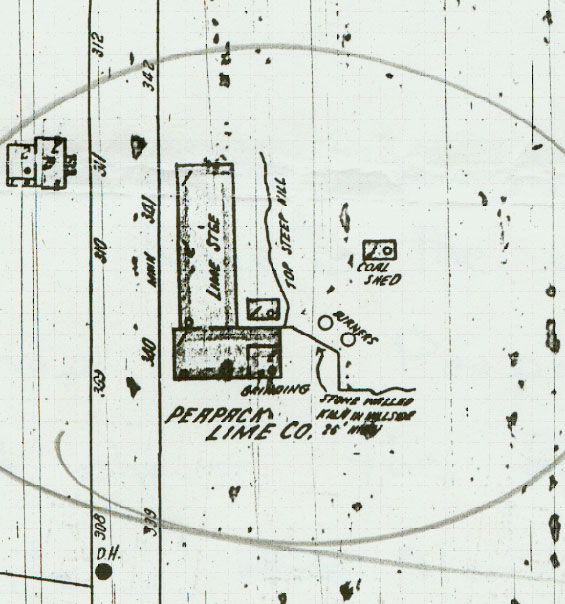
By the late 19th century pulverized lime had come to replace burnt lime for agricultural uses. Indeed, by the 1920s, the Peapack Lime Company was one of only firms still commercially producing lime fertilizer in New Jersey, and in 1929 the state‟s “entire reported output of lime … came from the plant of the Peapack Limestone Products Company at Peapack [which operated] two stone kilns of the discontinuous or „field‟ type‟.
The kilns remained in use at least until 1934, but were discontinued sometime thereafter, as the firm switched to pulverized lime and other products. Anthony Ferrante, owner of the Somerset Crushed Stone Co. in Bernardsville, announced in March 1948 that he had purchased the site from Peapack Lime Co.
Local residents still remember buying lime from the storehouse by the kilns in the 1950s, but the operation ceased in the 1960s and the quarry was abandoned. The quarry was still operating in late 1958 when a blast uncovered another cave that was subsequently closed. But operations appeared to cease in the 1960s. A portion of the tract was then used as a landfill from the mid-1960s until being abandoned in 1978.
A roadside sign for “Peapack-Gladstone Lime Kiln Park” said the park was the site of “lime burning” operations for 151 years – from 1794 to 1945.
Peapack Partners purchased 11 acres including the double kiln and former quarry from Komline-Sanderson Engineering in 1987. Peapack Partners initially sought to develop the site with 48 townhouses, but in 1994 it agreed to a legal settlement that allowed 11 single-family homes, of which 10 would be on the plateau above the kilns.
According to the 1997 THSSH Annual report, a land “owner in Peapack – Gladstone is planning to donate to THSSH property including two 18th century lime kilns. The kilns are in a marvelous state of repair and of great historical significance to the Somerset Hills. Ninety-five percent of the brush clearing has been completed and 75% of the grading and seeding is finished. THSSH is ready to take title to the property when two fences for safety of the public have been installed by the developer. We hope to open the site to the public in the spring of 1998.”
In early 1999, THSSH officially took title of the two 18th century lime kilns in Peapack. We had a festive grand opening on May 8, 1999 attended by 50 people, including members of the Peapack-Gladstone Cultural and Heritage Commission. Among the speakers were Ruth Thompson, President of the Heritage Commission, Mr. Gerardi, Mayor of Peapack-Gladstone, and June Campbell, Chairman of THSSH. The kilns are of great historical value to the Somerset Hills. This pocket park will enhance the historical interest of the community. Already a nearby restaurant has been named for it (Limestone Cafe – sadly, it is now closed). The Lime Kiln public area was dedicated, providing a story board about the preserved kilns and the agricultural heritage of the Somerset Hills. In 2000, a blue historic sign was dedicted to the Lime Kilns and placed on the park property.
Stated in the 2013 annualy report, The Society’s Executive Committee continued discussions with the Peapack-Gladstone Historic Preservation Committee regarding ownership and preservation of the local lime kilns.