Photo courtesy: The Bernardsville News/New Jersey Hills Media Group.
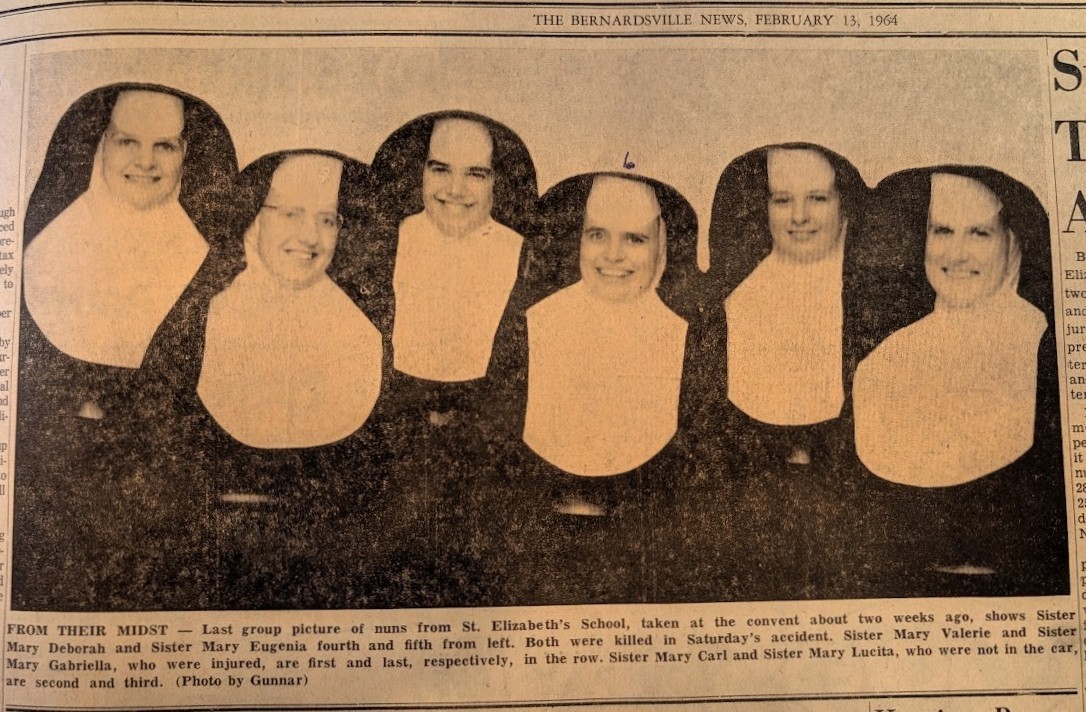
On February 8, 1964 on Route 22 near Newark Airport, a truck collided with a passenger car carrying four nuns from St. Elizabeth’s School in Bernardsville, NJ. Two sisters were killed and two seriously injured. Sister Valerie (the former Doris C. Dolbach), was school principal and driver and was injured along with Sister Gabriella (Mildred MacCausland). The deceased were Sister Mary Deborah (Jean Oliver of Red Bank), age 28, and Sister Mary Eugenia (Loretta Gavin of Phillipsburg) age 25. Sister Deborah taught 5th grade and Sister Eugenia, 4th.
The impact on the students, school, and the community was huge. St. Elizabeth’s 500 students came from across the area including Basking Ridge (St. James school did not open until 1965). However, under the leadership of Rev. John Torney, Our Lady of Perpetual Help parish reopened St. Elizabeth’s on February 13. Faculty roles were shuffled and all were committed to returning the school quickly to normal, notably lay teachers Carol Devlin and Albert Latino.
A Box of Fruit
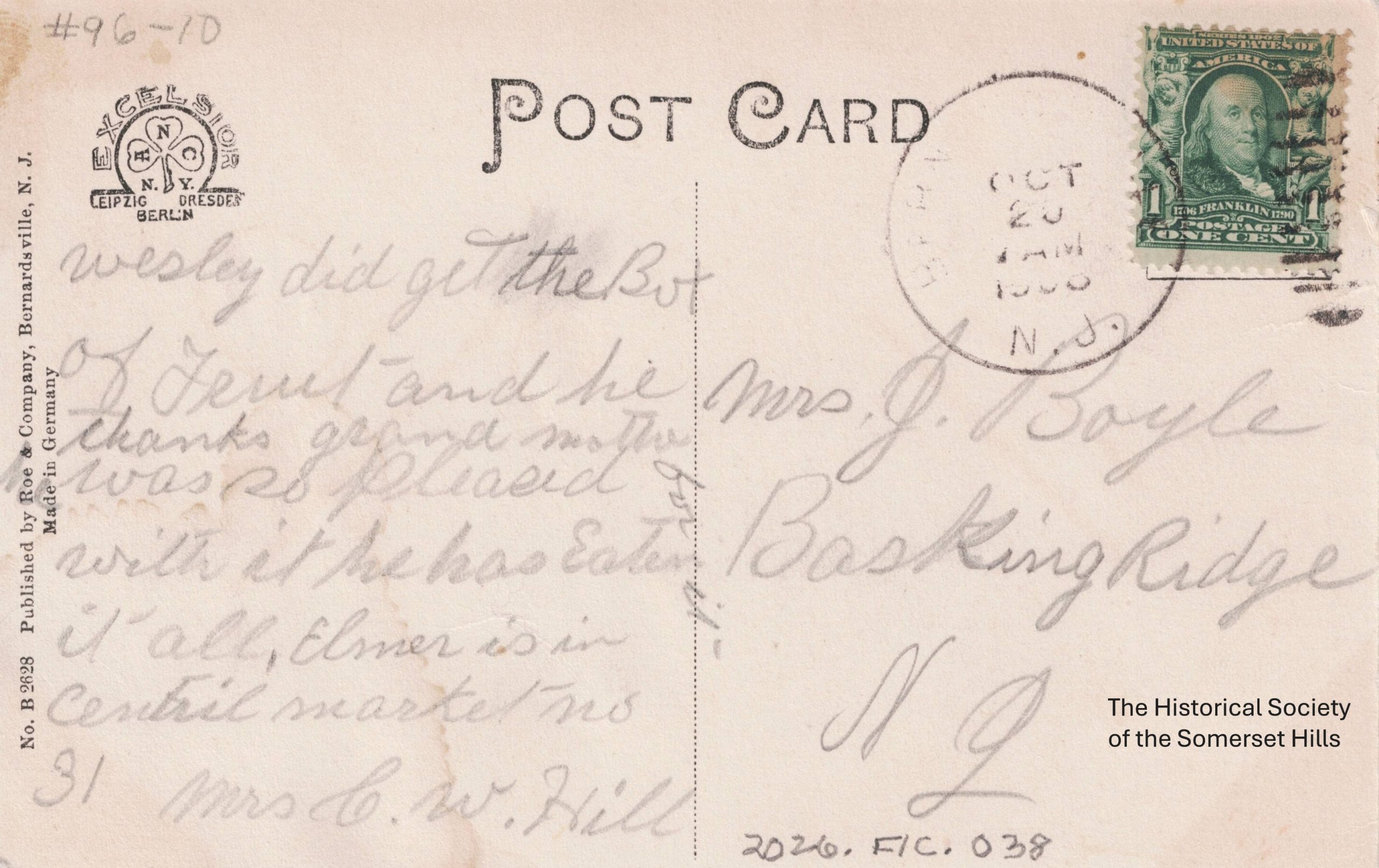
This vintage postcard shows a photo of Olcott Square in Bernardsville, NJ, with the old fountain. Manker Hall and the Boylan House are on the right–both of which are now headed toward demolition. The postmark is hard to read, but may be 1908. The image is well known[1], but this postcard is special because of the enormous amount of microhistory written in just a few words on the back:
Mrs. J. Boyle Basking Ridge, NJ Wesley did get the Box of Fruit and he thanks grandmother for it he was so pleased with it he has eaten it all, Elmer is in central market no 31 Mrs. C. W. Hill #96-10
The card is addressed to Mrs. J. Boyle by Mrs. C. W. Hill. Mrs. John Boyle (Sarah B. Faulkner Boyle) and Mrs. Charles W. Hill (Mary Buck Hill) were the two grandmothers of Wesley Hill (b. 1903) who received the box of fruit mentioned in the note. Elmer B. Hill (1879-1958), was the father of Wesley and son of Mary Buck Hill.
On the surface, the message appears a simple thank you from one grandmother to another, but why is the grandmother writing the thank you? Where was Wesley’s mother?
Wesley Hill was the son of Elmer B. Hill and Zillah Boyle and was about 5 years old in 1908. The 1905 Census enumerated Wesley and his parents in June 1905.
1905 NJ State Census, Bernards Township, Sheet 17(Bernardsville News, Sept. 15, 1905, p. 5)
Zillah Boyle Hill unfortunately died Sept. 14, 1905 of septicemia, probably after childbirth.[2]
One interpretation is that by 1908 when the postcard was sent, Wesley was living with his widowed father and his Hill grandparents. That was why his Hill grandmother sent the thank you note.
Elmer B. Hill went on to marry again and died in 1958. His son Wesley died in Florida in 1988.
How did THSSH get to preserve this sad story? A clue is in the number “#96-10” written on the postcard. It’s an accession number meaning that the card was received in 1996 and was the 10th accession of the year. THSSH records show that the card was a gift from Harold Koechlein (1913-1998). Koechlein was a grandson of Sarah Faulkner Boyle, the recipient of the postcard, which was likely handed down in the family.
For full catalog record of this postcard click HERE.
[2] Bernards Township, Return of Deaths, 1866-1917, Bernardsville Library Local History Room.
Passaic Valley and Peapack Railroad Company
Click to enlarge.
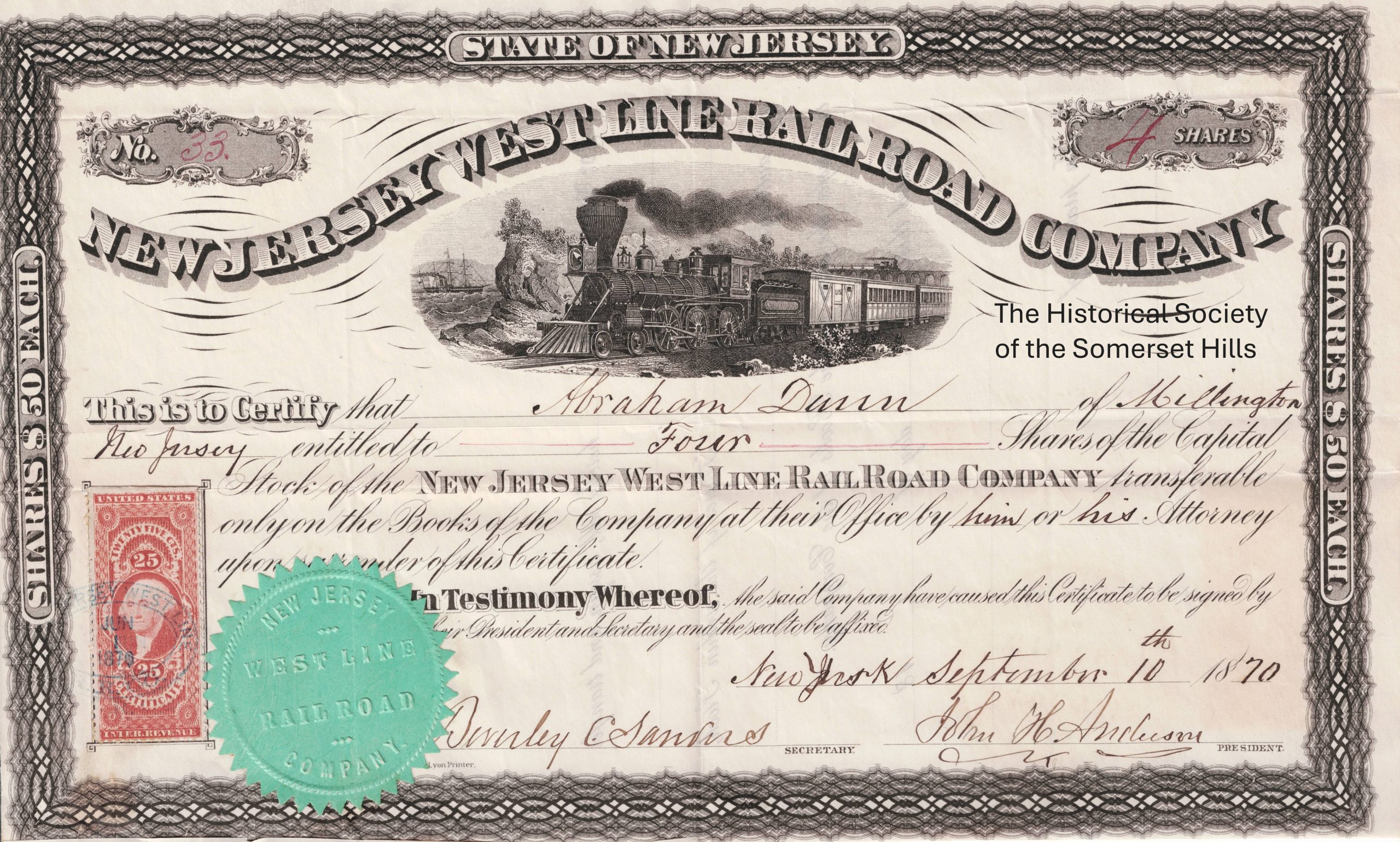
In 1865, the NJ state legislature authorized The Passaic Valley and Peapack Railroad Company to build a railroad from Essex or Union counties westward along the Passaic River to Basking Ridge and on to Peapack. A later amendment authorized an extension to the Delaware River between Milford and Frenchtown. John H. Anderson (1813-1875) of Bernards Township was President and Morris P. Crater (1800-1876) of Bedminster Township served as Treasurer. Local landowners like Abraham Dunn (1807-1874) of Passaic Township, whose lands the railroad crossed, and David R. Runyon (1796-1886) became stockholders. The certificate above was issued in 1866 to Runyon.
Click to enlarge.
The railroad’s ambitions were never fully realized. In 1870, the name was changed to the New Jersey West Line Rail Road and the tracks were completed to Bernardsville in 1872. It was 1890 before a successor company under control of the Delaware, Lackawanna and Western extended the line to Peapack and Gladstone where NJ Transit’s Gladstone Branch ends to this day.
A new set of records is now part of THSSH Online Collections. These documents form a new collection focused on Basking Ridge Fire Company No. 1, which was formed in 1904.
Items include old photos such as the one pictured above which shows the 1925 Firemens’ Carnival at Maple Avenue School with Fire Chief Ray Moffett (white coat). The photo also shows future chiefs Bryce Carswell, John Pope and Frank McGuirk. Another highlight is a department scrapbook of more than 60 pages which include newspaper clippings on fund raisers, memorable fires, and equipment. Did you know that in 1917, the company purchased its first electric siren? Before that, they relied on the Presbyterian Church bell to rally firemen. All documents are cataloged and keyword searchable.
To access the Basking Ridge Fire Company collection, CLICK HERE. Select a document to view the full Catalog Record. Once you open a document, you can search using your browser’s <Find> or <Find on Page> option, usually under the <…> symbol on the top menu. Long documents have abstracts which include the page numbers for the images. Images may be magnified using the <right click><More tools><Magnify image> options.
#NJFirefighters#FireDepartmentHistory
Bicentennial Quilt
Click to enlarge
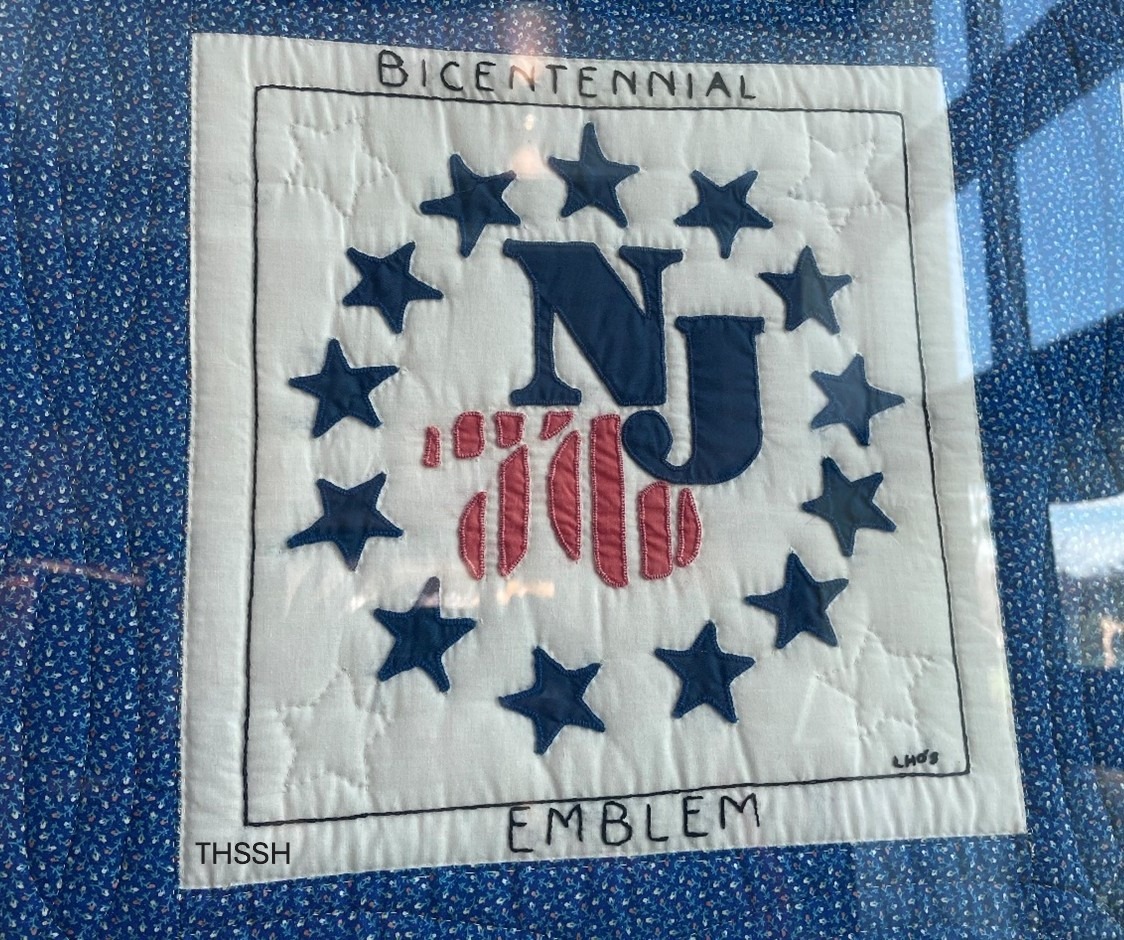
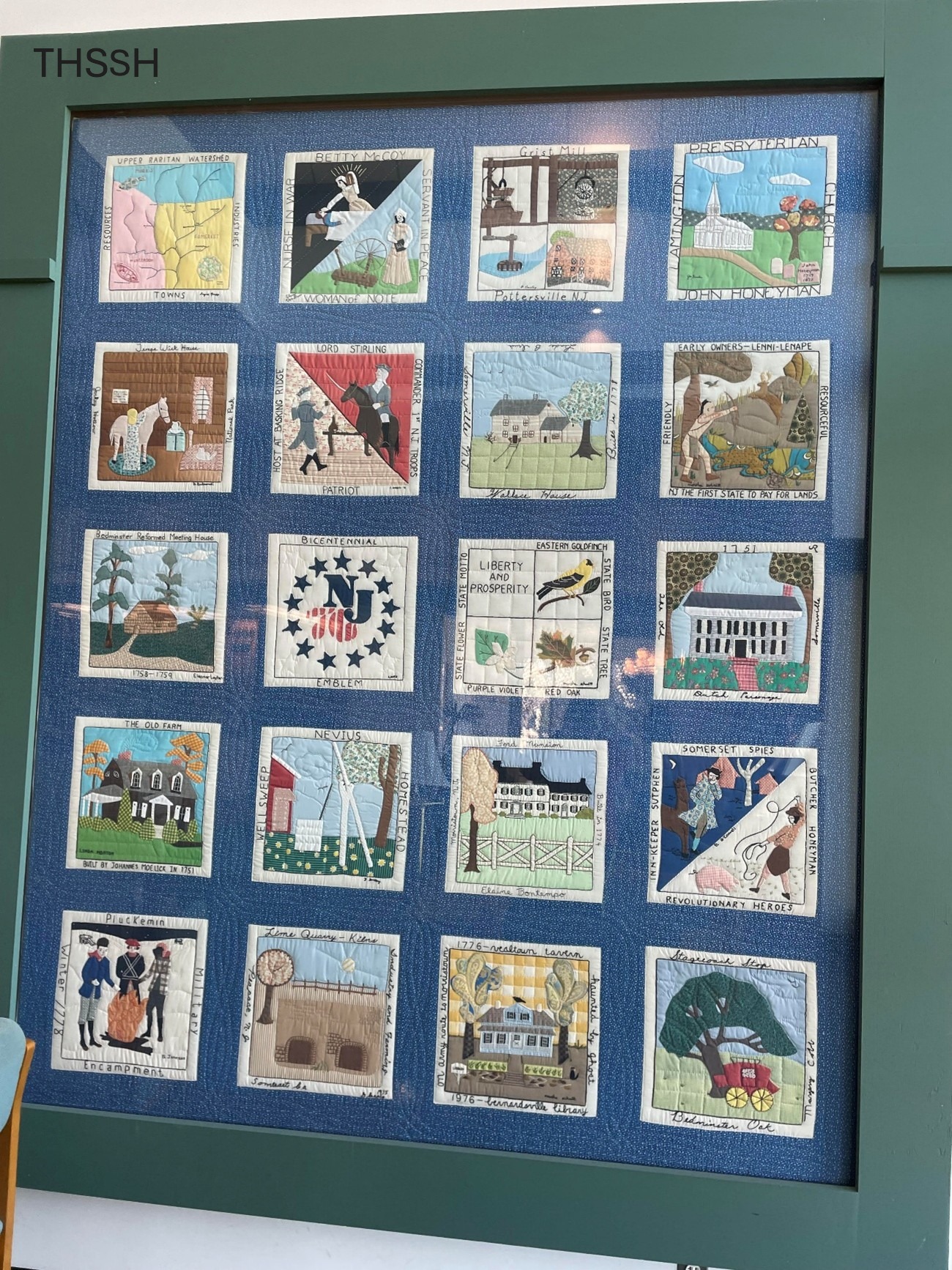
Amid the hoopla surrounding America’s 250th birthday this year, you may have missed the historic quilt quietly marking the event at Clarence Dillon Library in Bedminster. The quilt was actually created for the bicentennial in 1976, but it remains a celebration of our nation’s founding in the Somerset Hills of New Jersey 50 years later.
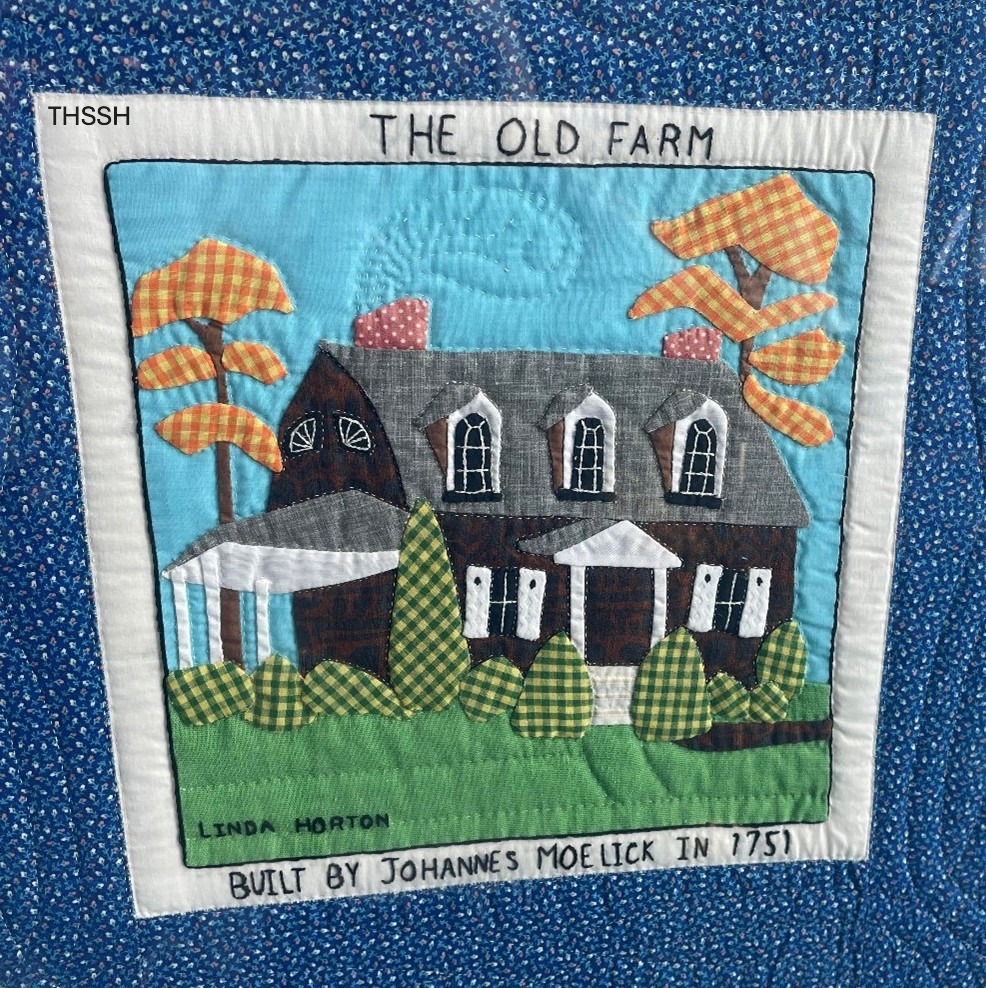
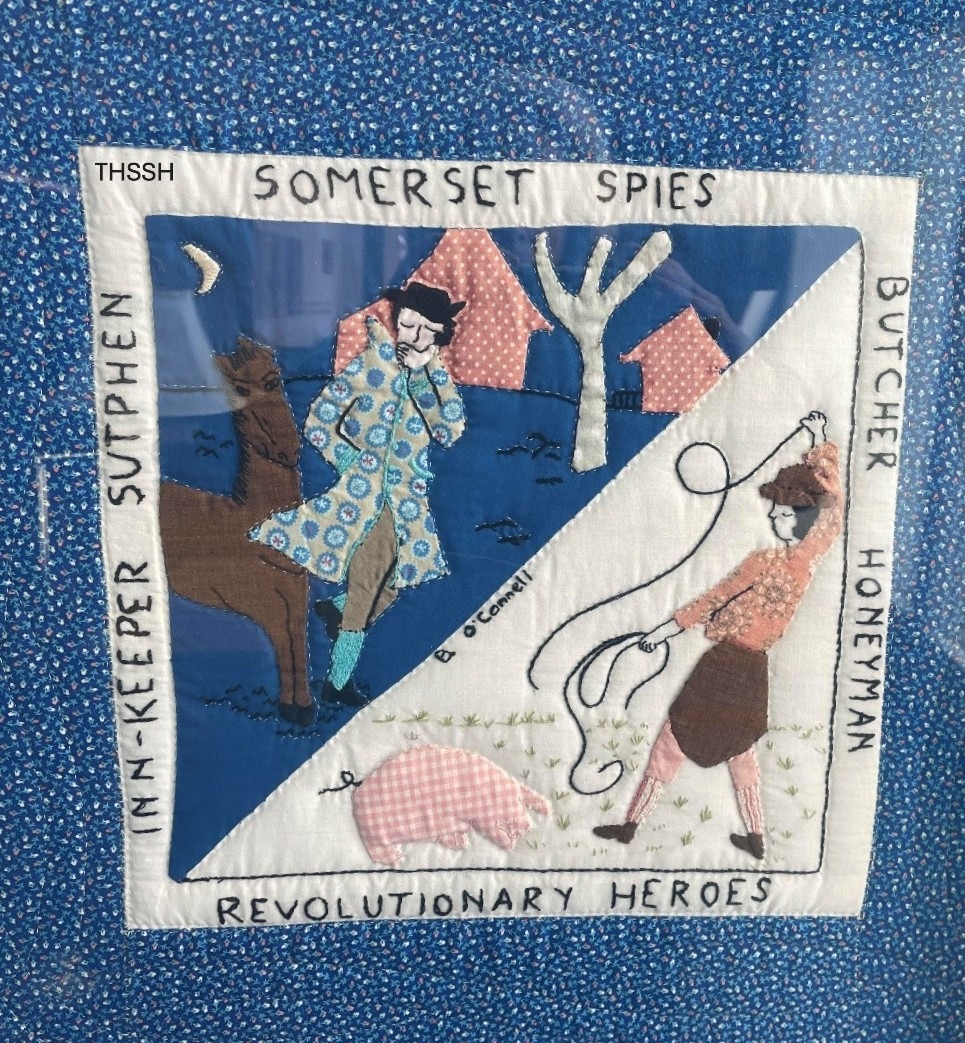
The quilt is made up of 20 individually designed squares and measures 81 x 100 inches. Eighteen women, mostly housewives and mothers from the Somerset Hills area made the quilt as a fund-raising project for what was then the Crossroads Public Library. Each square of 15 x 15 inches has an author who clearly loved our history. Each square depicts an important scene or person in our area during the Revolutionary War. The Crossroads Public Library was renamed the Clarence Dillon Public Library in 1979 after the Clarence and Anne Dillon Dunwalke Trust paid off the library’s mortgage.
Names of Quilters Florence Barberry Barbara Bartosenski Diane Bentley Elaine Bontempo Margery Cobb Gladys Craig Jean Grissler Linda Horton Linda Irvin Bonnie Johnson Pauline Keasling Eleanor Layton Barbara O’Conner Lou Helen O’Sullivan Jeanne Ratti Ingrid Raupp Martha Schmitt Elaine Van Dam
Fire Company Tambourine
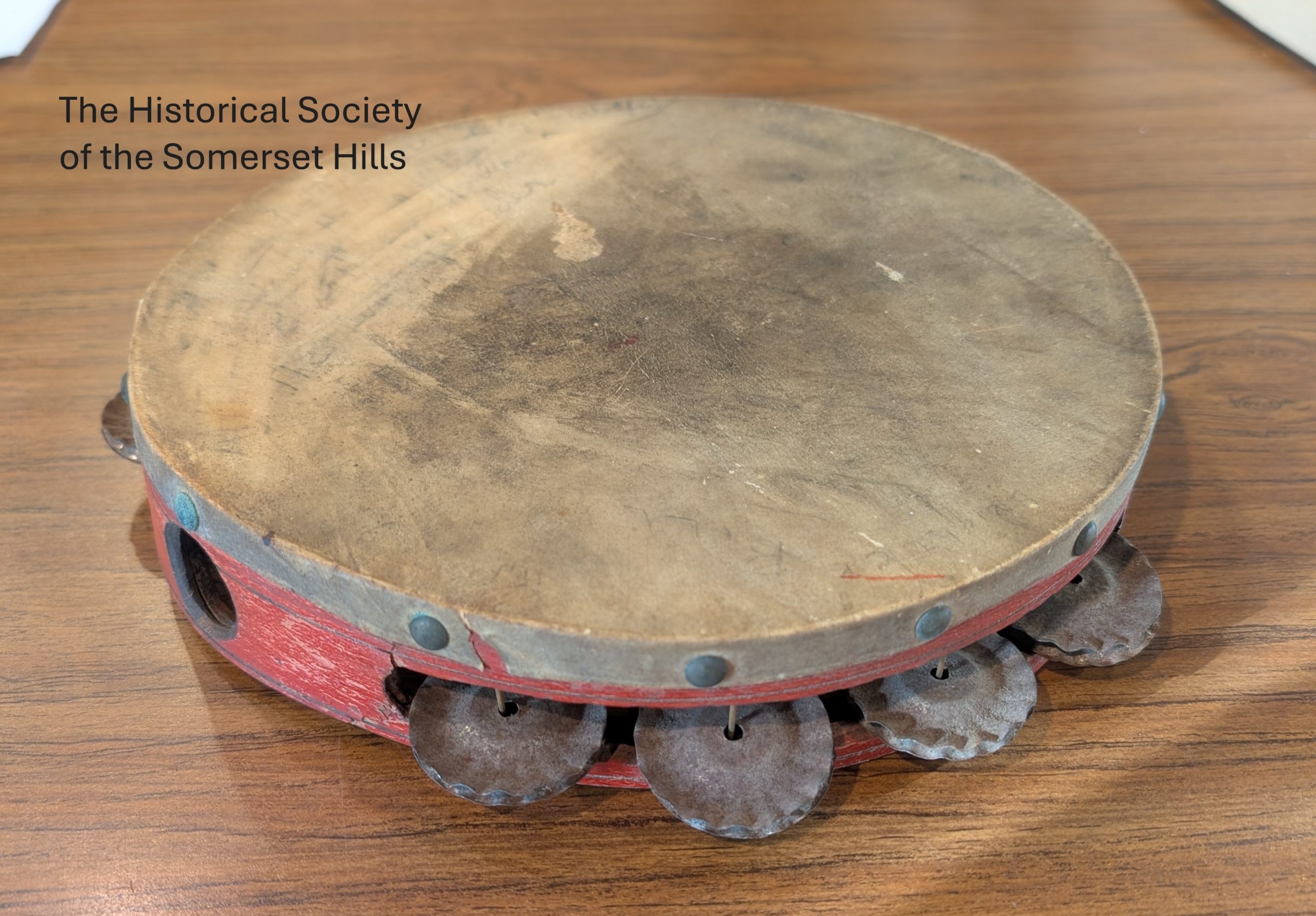
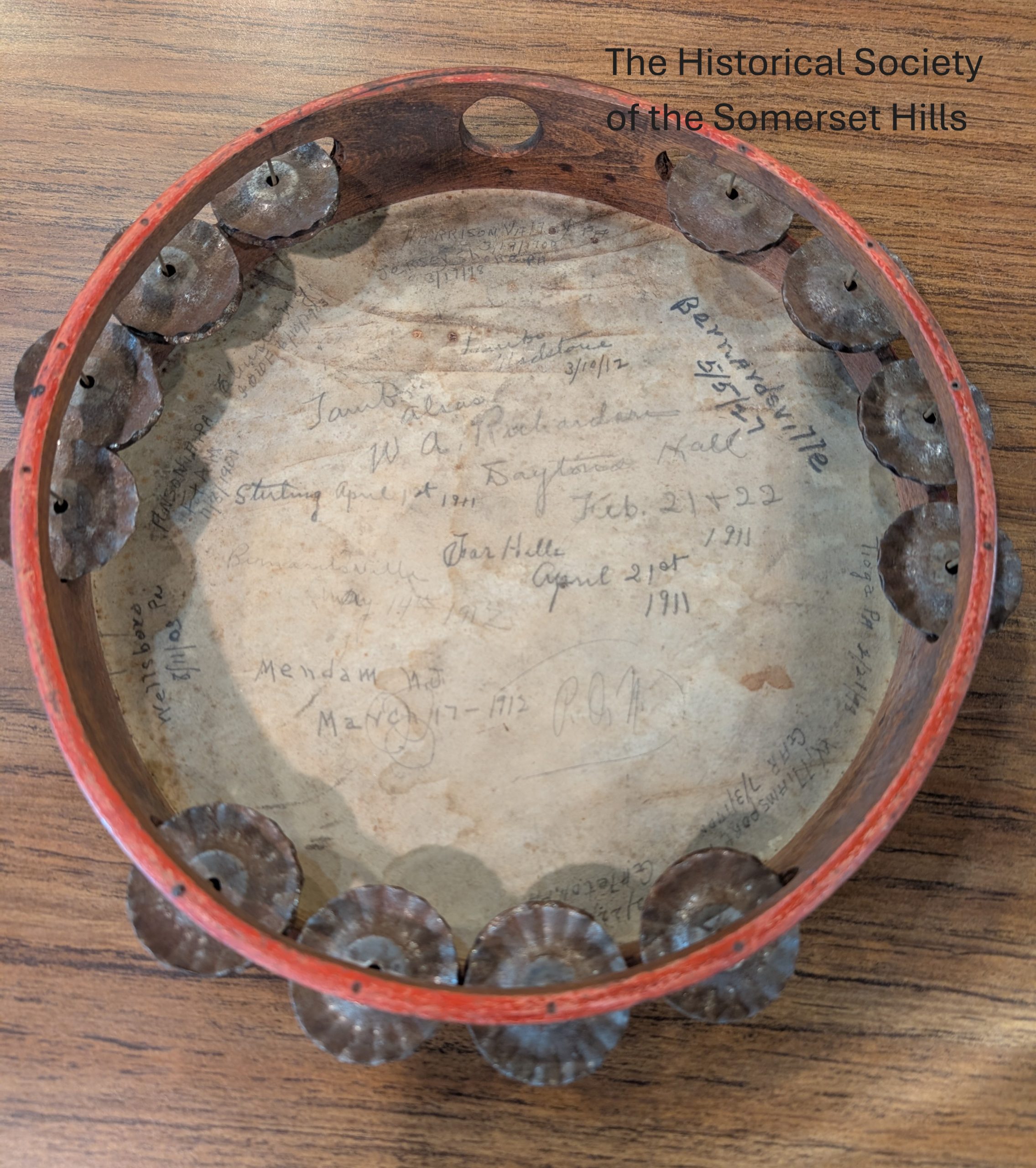
A tambourine that belonged to Chief William Arthur Richardson (1872-1935) of Basking Ridge Fire Company No. 1 is a recent addition to the society’s collections. Richardson moved to Basking Ridge by 1910 from Pennsylvania where he had been a fireman and had started using the tambourine in parades. He served as chief in Basking Ridge in 1918 and 1919.
From the dates written on the bottom, the tambourine was used in parades beginning in Pennsylvania and New York in the 1890s. An inscription for Dayton’s Hall, Feb. 21 and 22, 1911 shows that Richardson was present at a fire department fundraiser held there that year. Dayton’s Hall stood on North Finley Avenue where the current Presbyterian Church parking lot is. The last inscription was for an event in Bernardsville in 1927.
Names and Dates Written on Tambourine
[Top] ____ Wolfe [other writing smeared and illegible]
Click to enlarge.
[Bottom] Bernardsville 5/5/27 _____ Gladstone 3/10/12 W.A. Richardson Daytons Hall Feb. 21 & 22, 1911 Stirling April 1, 1917 Far Hills Apr 21, 1911 Mendham, NJ March 17, 1912 P O N [?] Elmira [?] NY I.O.O.F. 6/10/1903 Ansonia [?] PA F&AM 11/8/1901 Wellsboro 8/11/03 Harrison Valley 3/19/00 Jersey St[?] 3/17/98 Tioga PA 2/21/98 Williamsport GAR 7/3/1901 Gettleton [?] PA 2/22/97
What Is It? — A Quiz
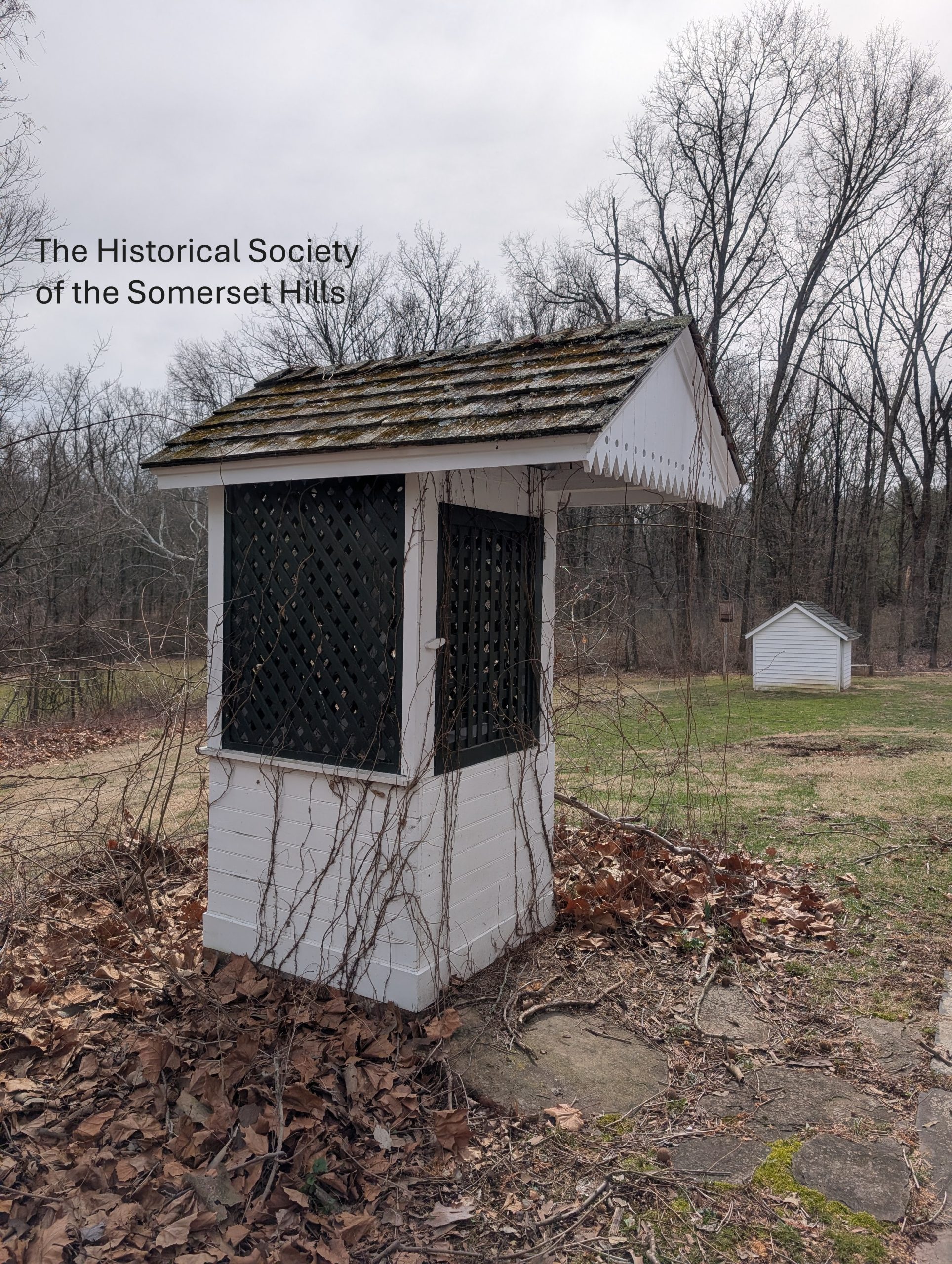
Structures like this one used to be common across the Somerset Hills. Does anyone know what it is? This photo is fairly recent—February 1971.
We’ll post the answer in a few days.
Wellhouse in March 2026
ANSWER: The building is a wellhouse. Wellhouses covered wells so no one accidentally fell in. They also provided a framework for a crank to lower and raise a water bucket.
This wellhouse still stands on the historic Kennedy-Martin-Stelle Farmstead (Farmstead Arts) on King George Road in Bernards Township.
The Peapack-Gladstone Scout Cabin
Site of Future Scout Cabin, Early 1934
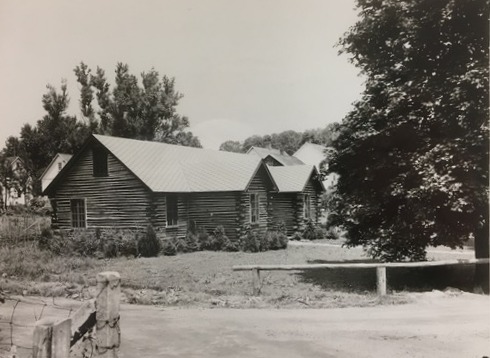
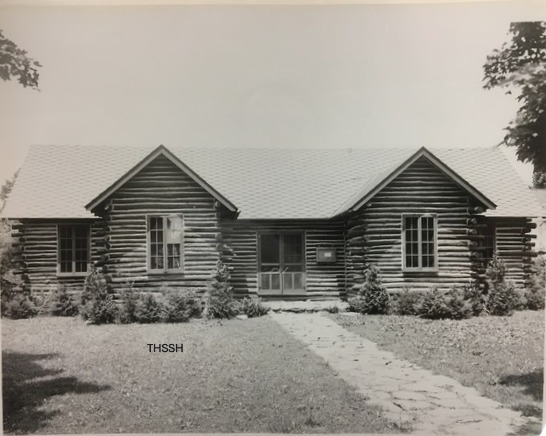
The Scout Cabin in the northwest corner of Liberty Park in Peapack, NJ, holds a rich history that reflects years of community service and tradition for the generations who have gathered within its walls. Built during the Great Depression, the cabin is believed to be the only Civil Works Administration (CWA) project specifically for the Boy Scouts. The log-cabin-style building consists of one large meeting area approximately 35 feet long by 20 wide, six 8-foot by 8-foot rooms and two lofts.
Scout Cabin in 1934
Background
The CWA was a short-lived jobs program established under the Federal Emergency Relief Administration during the Great Depression to rapidly create manual-labor jobs for about 4 million unemployed workers during the winter of 1933-34. During the program’s five-month duration, CWA workers laid 12 million feet of sewer pipe, built or improved 255,000 miles of roads, and constructed 40,000 schools, 3,700 playgrounds, nearly 1,000 airports and one log cabin.
Troop 57 Scoutmaster Harold Horton and county engineer and designer Oscar Smith went to Washington, D.C. to get permission to build the cabin with CWA funds. They received a budget of $2,500 for the project. Logs were harvested by CWA workers at the borough-owned water reservoir property in Chester, New Jersey. The construction was supervised by Thomas Howard, who built and operated the Peapack Hotel (formerly the Howard House hotel), at the corner of Main Street and Holland Avenue, now the site of Hamilton Court. Construction began on March 12, 1934, and the completed structure was dedicated on June 9, 1934. Following a parade through town, Mayor Reginald B. Rives served as master of ceremonies and New Jersey Governor A. Harry Moore made the dedication.
Scout Cabin in 1934
The Scout Cabin was home for Troop 57 until the troop folded and merged with Troop 150 in Bernardsville around 1990. The cabin then served for a time as the weekly meeting place for the Lone Eagle Composite Squadron of the New Jersey Wing of the Civil Air Patrol. Following the departure of the air patrol, the cabin was used principally for storage by the borough.
Restoration 2023
While the borough had added a new roof to protect the structure, the Scout Cabin had not received much attention in many years and needed a makeover. Thirteen-year-old Gladstone resident and member of Boy Scout Troop 150, Thomas W. Whittle IV, approached the borough and proposed refurbishing the cabin as his Eagle Scout project.
An Eagle Scout project requires a scout to plan, manage and lead a project that benefits the community. A project typically includes identifying a community need, obtaining permission from the project’s sponsor, planning the project activities, raising funds, buying supplies and materials, recruiting volunteers, scheduling workdays, instructing the volunteers and assigning them tasks, demonstrating the safe use of tools, supplies and materials, answering volunteers’ questions, checking the completed work, and ensuring the project is completed on time and on budget to the satisfaction of the sponsor.
The Borough Council approved the Scout Cabin refurbishment project in October 2023 with the expectation that the cabin would be ready for the borough’s annual holiday event the first week in December.
The ambitious project encompassed work on the exterior and interior of the cabin. The exterior work included: removing chicken wire screens that protected the windows; taking off the broken shutters; cleaning out mud wasp nests from the exterior walls; and sanding, scraping, and repainting the outside of the window sashes and frames. The double set of front doors were also sanded and given a fresh coat of red paint to give the cabin a welcoming look.
Before getting started inside, the Peapack-Gladstone Department of Public Works (DPW) and Recreation Department removed items stored in the cabin. Once completed, the interior work included: removing trash and debris throughout the cabin; sanding, scraping, and repainting the inside of the window sashes and frames; washing the windows; and giving each room and loft a thorough cleaning from top to bottom including the wooden beams, walls and floors. An iron wagon wheel chandelier in the main room was taken down, stripped of its paint, and refurbished with new paint, wiring and lights. A new, secured box was built around the electrical panel. A display case was cleaned and filled with the Troop 57 memorabilia that was found in the cabin, including the troop flag and various awards.
Refurbishing the old building came with challenges too. The main room of the cabin features a large fieldstone fireplace and massive black oak mantel with a large buck mounted above them. Upon initial inspection of the cabin, it was noted that the mantel had pulled off the wall and the inset wooden posts holding it up had rotted, posing a hazard to occupants of the building. The DPW was asked to bring in a carpenter to reset the mantel properly. While the repair was a success, it resulted in a new layer of sawdust throughout the cabin that required a second top-to-bottom cleaning.
Completion
The project was completed with the assistance of 57 volunteers, including 22 adults and 35 youths, that put in approximately 325 manhours. Almost $2,700 was raised from donations for the refurbishment, a sum greater than the original cost of building the cabin. Excess funds were donated to the Peapack-Gladstone Environmental and Shade Commission to assist with plantings added to beautify the landscape around the cabin.
The project garnered a great deal of attention and excitement from visitors to Liberty Park. Each workday, people stopped by to see the cabin, ask questions about its history and the ongoing project, and to share their own stories about being a member of Troop 57 in the cabin.
The project was completed in time for Santa’s annual visit to Peapack Gladstone, hosted by the Peapack-Gladstone Recreation Department on Sunday, December 3, 2023. Santa greeted the children with candy canes and hot chocolate in front of a roaring fire in the fireplace. There was nothing more rewarding than seeing the whole community come together for this special event in a beautiful space. Most of those attending the event had never been inside the cabin. Since then, the cabin has hosted a dog show and other community events.
The project could not have been completed without the support of Councilwoman Jamie Murphy, who served at the project’s sponsor, and the rest of the Peapack-Gladstone Council and Mayor. Brad Fagan and the members of the Peapack-Gladstone Department of Public Works were instrumental in providing logistical assistance throughout the project. Daniel Dolan of the Peapack-Gladstone Recreation Department helped get the word out to the community about the need for additional volunteers.
Thomas W. Whittle IV completed his project in November 2023 and earned the rank of Eagle Scout in June 2024. He is currently a sophomore at the Kent School in Kent, Connecticut.Historic photos courtesy of W. Barry Thomson.
Scout Cabin Before Restoration
ngg_shortcode_0_placeholder
Scout Cabin After Restoration
ngg_shortcode_1_placeholder
Somerset Inn Postcard
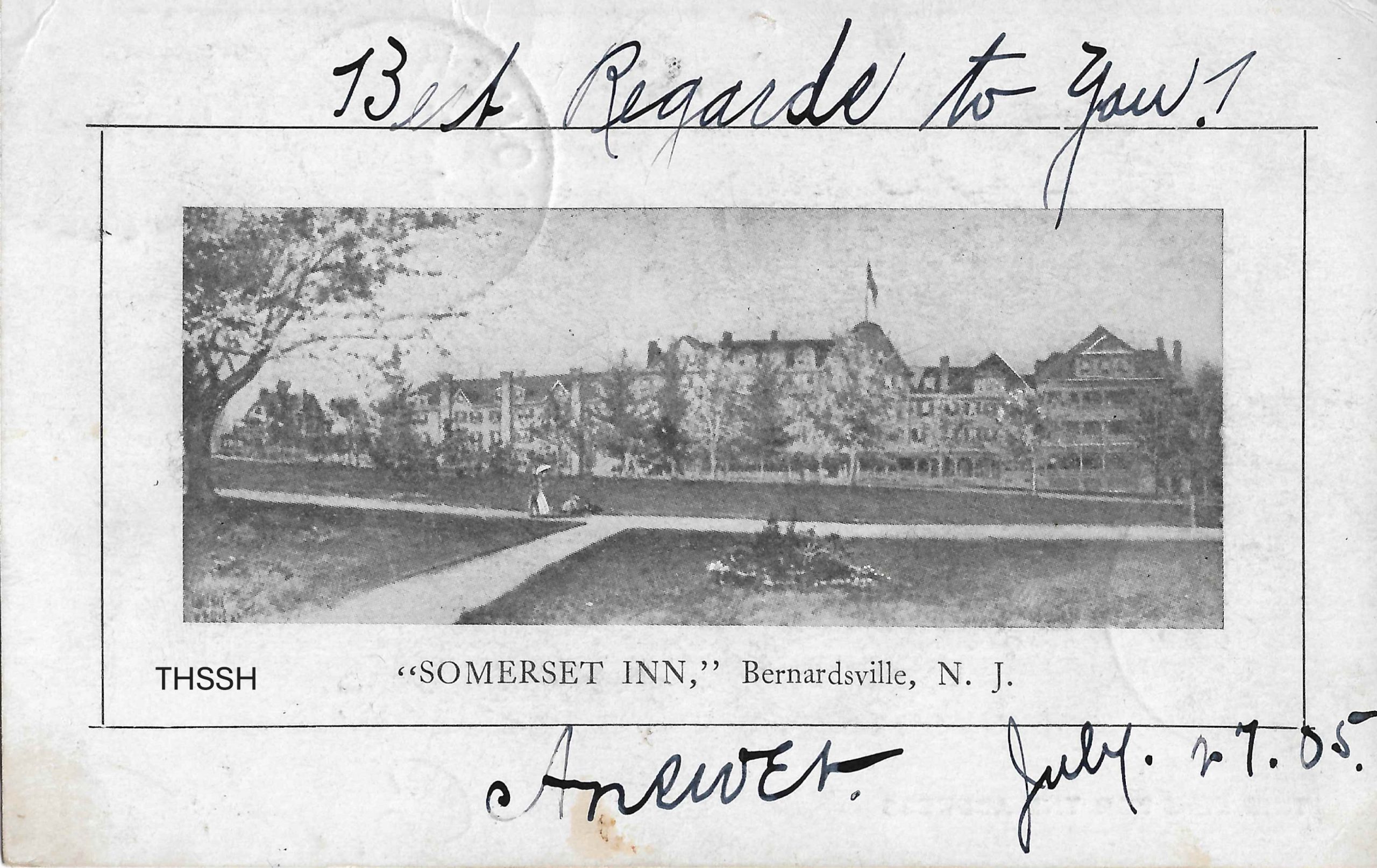
A postcard from 1905 shows the Somerset Inn, located in Bernardsville, NJ.
The inn stood on Mendham Road, near Washington Corner Road and became a resort destination for the rich and famous in society after the railroad was extended (1872) to Bernardsville. Many guests liked the area so much that they later built homes of their own in the surrounding hills.
This postcard is especially interesting because it was postmarked at the Inn, which had its own post office along with many other amenities like tennis courts, swimming pool, and a golf course. The Inn could accommodate up to 500 guests.
The card is addressed to Miss Dora Satterlee, Big Indian, Ulster Co., NY. Big Indian was and is a small hamlet in the Town of Shandaken in the Catskill region. Dora Satterlee (1881-1966) was easily located there on the 1905 NY State Census. She went on to marry (c.1905) William Lundergun.
The Somerset Inn burned to the ground in a disastrous fire in 1908.
Honnell and Bunn
Click to enlarge
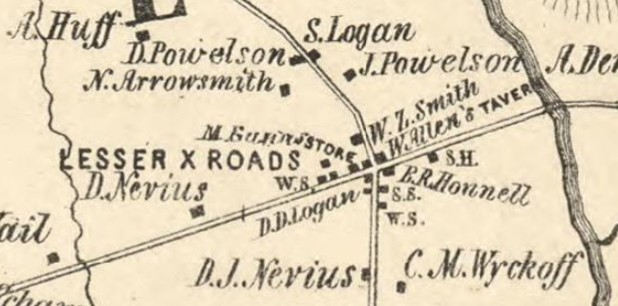
The nooks and crannies at the THSSH archives often hold hidden gems, and this empty envelope addressed to Messrs. Honnell and Bunn is a good example. Honnell and Bunn were grocers in Bedminster village (then called Lesser Crossroads) as early as 1850. On the 1850 census, Benjamin R. Honnell (1818-1894) and Martin Bunn (c.1812-1887) were enumerated next to one another and both were listed as merchants. An 1850 map of Bedminster shows the store located at the corner of Lamington Road and Hillside Avenue, across from the Bedminster Inn (now Delicious Heights).
1850 U.S. Census, Bedminster Twp., NJ
The envelope’s postmark reads New York, but has no legible date. The year 1880 is written in pencil on the envelope and that date is credible because the stamp is a blue Franklin 1 cent (Scott #182), first issued in 1879.
Both Honnell and Bunn lived in Bedminster until their deaths and are buried in the Bedminster Reformed Church Cemetery.
Perhaps THSSH volunteers will someday find the letter’s contents.
From Map of Somerset County, Lloyd Van Derveer, 1850.