Editor’s Note: The Historical Society recently received an inquiry from a technician who services the commercial building at 125 South Finley Avenue in Basking Ridge. He reported seeing an apparition of a young boy in Civil War-period clothing in the basement. The technician was aware that a physician, who had served in the Civil War, had once lived there and wanted to know more about the family. The following research report was prepared by W. Barry Thomson in response and is quite intriguing!

The Second Empire-style house at 125 S. Finley Avenue (previously known as Main Street) was built circa 1871 by and for Dr. Horatio Goodell Whitnall (born 1839-40; died 1920), his wife, Amanda Elizabeth Minard (born ca. 1840; died 1921), and their children.
According to the brochure published in 2005 by the Historical Society of the Somerset Hills, A Walking Tour of Historic Basking Ridge Village, the house was constructed for the Whitnalls by local builder Crayton Space, who is also credited with building the Washington House Hotel (now the Washington House Restaurant) the same year as the Whitnall house, 1871.
Amanda Minard Whitnall’s father was Abel Minard (1814-1871), a wealthy Methodist philanthropist who, toward the end of his life, lived in Morristown where he founded and endowed the Minard Home for the education of female orphans of Methodist missionaries and clergymen. Upon his death, Mr. Minard also
left a sizable sum to what was then the Drew Theological Seminary.

Amanda Elizabeth Minard and Horatio Goodell Whitnall (who was generally known by his middle name) were married in June 1867 by Methodist Bishop Edmund S. Janes. One might speculate that Amanda’s likely inheritance from her well-to-do father in 1871 may have been the source of funds for the construction of the Whitnalls’ house in Basking Ridge. The Whitnalls also accumulated a sizable amount of property in and nearby the village of Basking Ridge. The family’s farm was, reportedly, a 250-acre tract to the south of West Oak Street and Evergreen Cemetery. In 1924, the Whitnall farm was the site of a large gathering of the Ku Klux Klan, with newspaper reports estimating the number of attendees at several thousand people.
The Whitnalls, who lived in Morristown after their 1867 marriage, acquired the 125 South Finley Avenue property in Basking Ridge by deed dated April 1, 1871, from Rosa J. Doty (the widow of Daniel W. Doty) and her two sons, Daniel S. and Samuel S. Doty. The price paid was $2,750. Daniel W. Doty had acquired the property in 1837 from David and Esther Sanderson. The 125 South Finley Avenue property remained in the Whitnall family until 1939.
Now it gets interesting in light of the recent experience in the 125 South Finley building. According to the 1910 United States Census, Amanda Whitnall had given birth to six children, of which only four were then living: daughters Harriet and Gertrude, who never married; Alice Christine, who married William N. Flynt, and son Charles. The other two children died young and were buried in Evergreen Cemetery in Basking Ridge: Mary C. Whitnall, who was born in 1872 and died only five months later in January 1873; and son Abbot M. Whitnall, who was born in 1871 and died August 23, 1875 at the age of 4. The Whitnall plot (#80) at Evergreen Cemetery in Basking Ridge contains the remains of six family members: Horatio Goodell Whitnall, wife Amanda Elizabeth Whitnall, daughter Mary C. Whitnall (1872-1873), son Abbot M. Whitnall (1871-1875), daughter Christine Whitnall Flynt (1879-1951), and Christine’s husband, William N. Flynt (1880-1946). The only plot markers are for Christine and William Flynt.
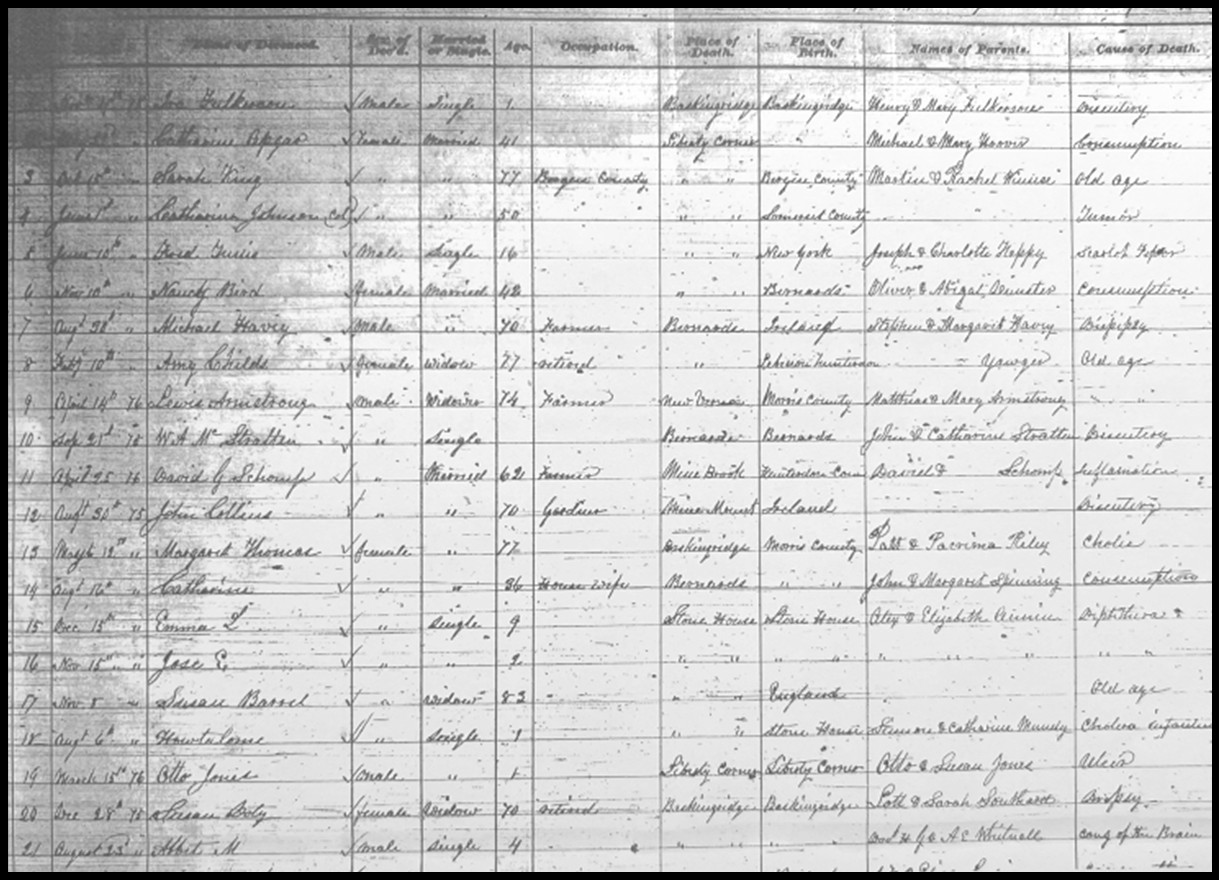
The New Jersey State Archives has the death certificate of young Abbet (different spelling at bottom left). It was more of a chart listing many people including date of death, name of person, age at death, occupation, place of death, names of parents, and cause of death. His cause of death was listed as “cong of the Brain.” The term congestion of the brain appears to have covered various ailments (e.g. meningitis, swelling of the brain, stroke or excessive blood or other fluid around the brain), not all of which could be accurately diagnosed given the state of medicine in the 1870s. Thus it appears impossible to be more exacting as to the true cause of Abbot’s premature death.
Hmmm…could the young boy apparition have been Abbot M. Whitnall?
[This article appeared originally in the October 2023 issue of Inside the Brick Academy, the newsletter of The Historical Society of the Somerset Hills.]