British Army Officer Finds Peace and Honor in Pluckemin, NJ

Even in the heat of battle, there are moments that unite us as human beings. One such moment occurred on January 5, 1777 in Pluckemin, NJ. British Army Officer Capt. William Leslie, son of a Scottish nobleman, had been mortally wounded by the Continental Army at the Battle of Princeton January 3, 1777. He was just 26 and far from home. Almost by chance, the only two Americans who knew of him were in close proximity when he fell. “He fought his last battle almost within the walls of a college whose president, John Witherspoon, was the lifelong friend of his parents,” according to Andrew Mellick in “The Story of an Old Farm.” Witherspoon and Leslie’s mother were both devout Presbyterians and kept up a continuous correspondence about how the church was doing in America.
Another friend of his parents, Surgeon Benjamin Rush, was with General Washington at the battle and came to Leslie’s aid almost immediately. Rush had become friends with Leslie’s parents while a student at the University of Edinburgh. He showed great care and kindness to Leslie but could not save him. Leslie died during the march to Pluckemin, where the Continental Army rested for two days before moving on to Morristown. Leslie’s body was placed “probably in Eoff’s Tavern”, now the site of the Pluckemin Inn, while it was prepared for burial with full military honors.
Burial
A detachment of about 40 Continental Army soldiers accompanied the body “in slow time and with solemn step” from the Tavern to the Lutheran churchyard [now Pluckemin Presbyterian] where an open grave had been dug near the head of Johannes Moelich, the German farmer who was the central figure in “The Story of An Old Farm.” “There were wet eyes and true grief at that sepulchre, for Doctor Rush was not the only mourner present. Among the citizens and military clustering about the bier were the captured British officers, whom Washington had generously permitted to be present in order that they might bid a final adieu to their comrade in arms who had been much beloved.” It is said that military honors were accorded, due to the American army’s desire to pay respect to Leslie’s gallantry and bravery in battle.
Gravestone
Rush’s devotion to Leslie did not stop with his burial. He marked the grave with a brown headstone that lasted 60 years. In about 1835, the Earl of Leven asked Professor John D. Ogilby of Rutgers College, who was in Scotland, to find and, if necessary, remark the grave. When he returned to America, Ogilby contacted the father of Andrew Moelich/Mellick, the author of “The Story of an Old Farm,” asking for information on the location of Leslie’s grave. They visited Pluckemin together and had the present stone set up with the original inscription.
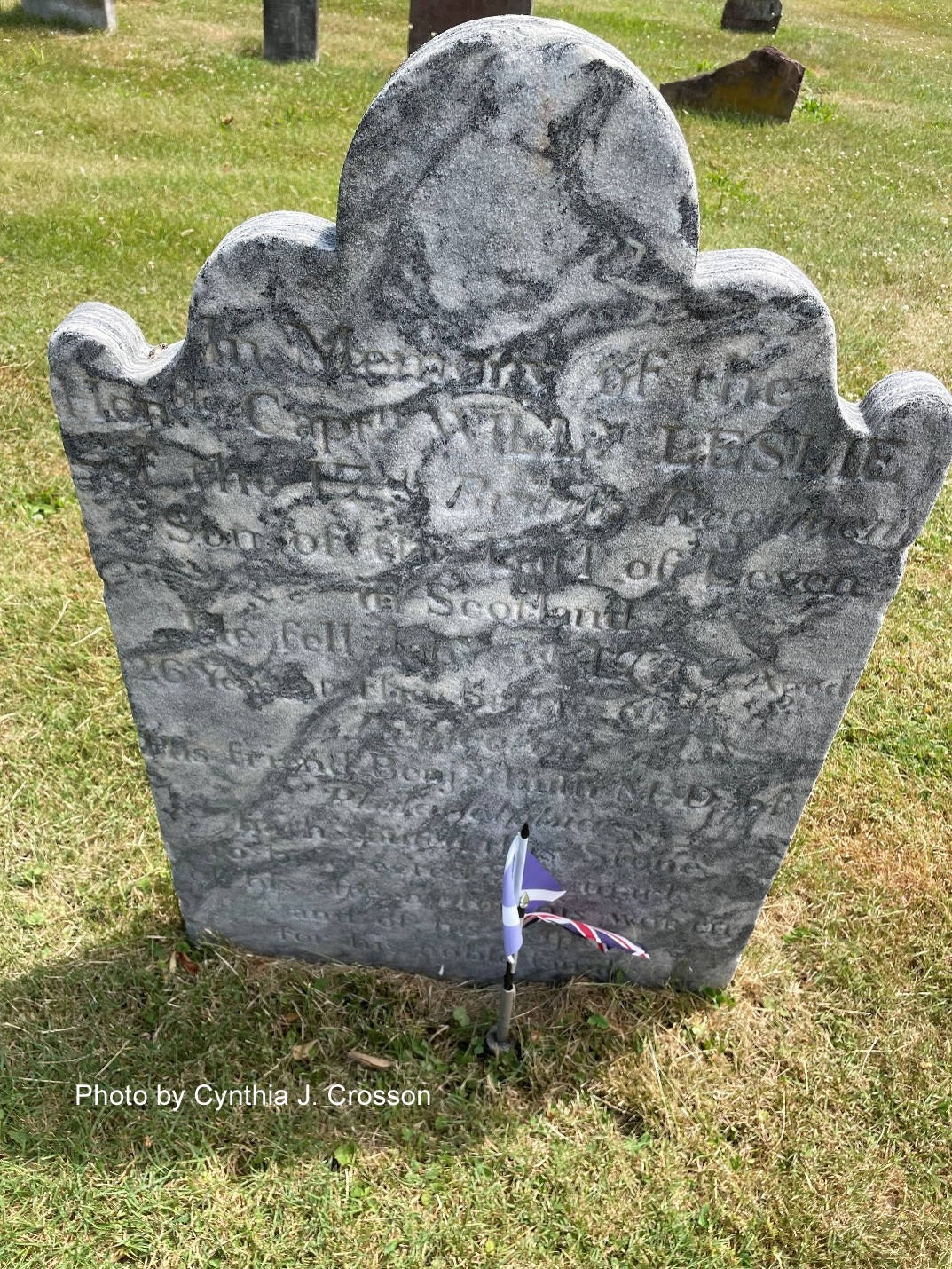
“In memory of the Hon Captain William Leslie of the 17th British Regiment, son of the Earl of Leven in Scotland. He fell January 3d, 1777, aged 26 years, at the battle of Princeton. His friend Benjamin Rush, MD of Philadelphia, caused this stone to be erected as a mark of his esteem for his worth and respect for his noble family.”
Sources:
“The Story of an Old Farm,” Andrew Mellick, pp. 378-387.
Museum of the American Revolution